









Introduction: A Gala That Turned Into a Global Tech Moment
Every year, hundreds of millions of viewers tune in to watch China’s Spring Festival Gala—the world’s most-watched television event. Traditionally a stage for music, comedy, and cultural storytelling, the gala has increasingly become something else: a platform for technological display.
In 2026, during the Year of the Horse, that transformation reached a new level.
Humanoid robots did not merely appear—they dominated the stage.
From performing martial arts to dancing alongside celebrities, from acting in comedy sketches to demonstrating household tasks, robots became central protagonists in multiple segments of the show. What might once have been seen as novelty quickly evolved into something more consequential: a coordinated demonstration of China’s rapid progress in embodied AI and robotics.
Within hours of broadcast, clips spread across global social media platforms. International audiences reacted with a mix of amazement, skepticism, and unease.
For many, this was not just entertainment.
It was a signal.
A “Robot-Heavy” Gala Unlike Any Before
The 2026 gala marked a clear escalation in both scale and sophistication.
More than 200 humanoid robots appeared across at least 12 programs, making it one of the most robot-intensive televised events in history.
Four major Chinese robotics companies were prominently featured:
- Unitree Robotics
- Galbot (Galaxy General)
- MagicLab (Magic Atom)
- Songyan Dynamics
Each company showcased a different dimension of humanoid robotics, effectively turning the gala into a multi-scenario technology exhibition rather than a single performance.
This was not accidental.
Industry observers increasingly describe the event as a “national-level technology showcase”—a stage where innovation, culture, and industrial signaling converge.
Martial Arts Meets Machine Intelligence
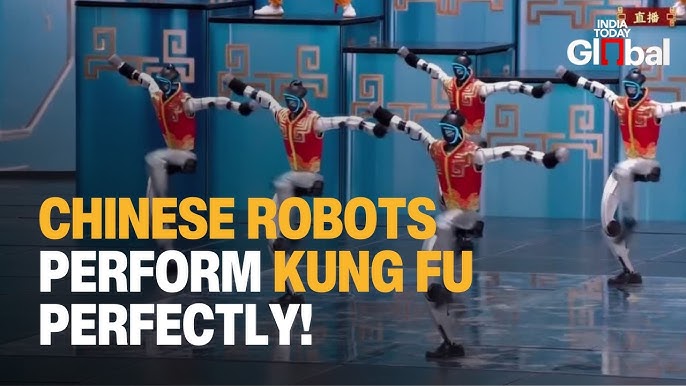
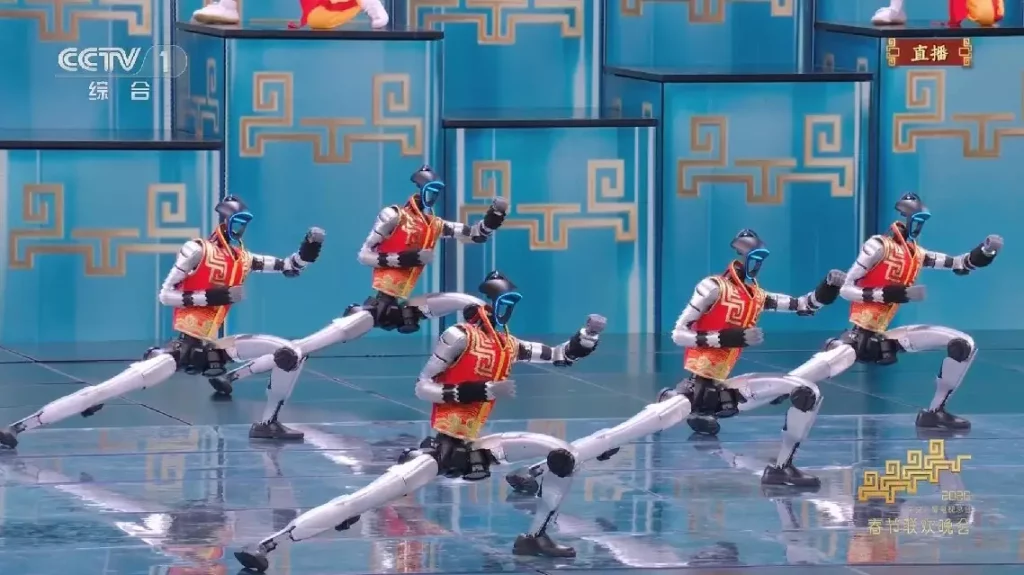
The most talked-about segment was a martial arts performance often referred to as “WuBOT.”
In this program, humanoid robots:
- executed synchronized kung fu routines
- performed high-speed running formations
- completed aerial flips and weapon sequences
Some robots even mimicked “drunken boxing” (醉拳) movements—traditionally one of the most complex and expressive martial arts styles.
The technical achievement behind this performance is significant.
According to reports, robots were able to:
- jump up to 2–3 meters into the air
- perform consecutive flips
- maintain balance after dynamic landings
- coordinate in real-time group formations
These capabilities were enabled by:
- high-frequency motion control systems
- reinforcement learning training frameworks
- onboard perception and navigation systems
Crucially, many of these actions were performed without external positioning systems, relying instead on onboard sensors and AI coordination.
For robotics experts, this marked a leap from controlled demonstrations to high-dynamic, real-world capable movement systems.
Beyond Motion: Emotion, Interaction, and Intelligence
While athletic performance captured attention, the deeper breakthroughs were less visible.
1. Emotional Expression
In a comedy sketch, a humanoid robot modeled after a well-known actress displayed:
- synchronized lip movement
- subtle facial expressions
- natural head and body motion
This was achieved using:
- dozens of micro-actuators in the face
- AI-driven expression modeling
- large datasets of human performance
The result approached a level of realism that blurred the line between human and machine—raising both excitement and discomfort.
2. Household Capabilities
Another segment showcased robots performing everyday tasks:
- folding clothes
- preparing simple food
- assisting elderly individuals
These demonstrations highlighted the industry’s shift toward practical applications, rather than pure performance.
Some of these robots are already being deployed in industrial settings, with thousands of units reportedly ordered by major manufacturers.
3. Autonomous Decision-Making
Perhaps the most important development was cognitive.
Unlike earlier generations of robots, which relied heavily on pre-programmed routines, some systems demonstrated:
- real-time adaptation to stage conditions
- interaction with human performers
- autonomous task planning
Industry analysts describe this as the transition from:
“robots as tools” → “robots as agents”
A One-Year Leap: From Folk Dance to Full Autonomy
The contrast with the previous year’s gala is striking.
In 2025, robots performed relatively simple synchronized dances—impressive, but limited in complexity.
By 2026, the same stage featured:
- dynamic acrobatics
- real-time interaction
- emotional expression
- task execution
Observers noted that the progress within a single year was “astonishing,” with some calling it an example of “China speed” in robotics development.
This rapid iteration reflects broader trends in the industry:
- faster hardware development cycles
- integration of AI foundation models
- large-scale data collection through simulation and teleoperation
Global Reactions: Awe, Doubt, and Competition
The international response was immediate.
Clips of the performances circulated widely, prompting reactions from:
- technology journalists
- AI researchers
- general audiences
Some viewers questioned whether the footage was real.
Others expressed surprise at the level of advancement.
One widely shared sentiment was that the demonstrations suggested a narrowing—or even reversal—of the perceived technological gap between China and the West.
According to international coverage, some commentators described the performance as evidence that:
China’s robotics development is accelerating faster than many expected.
At the same time, the event fueled discussions about global competition in AI and robotics, particularly between China and the United States.
The Industrial Message Behind the Spectacle
While the performances were theatrical, their purpose was strategic.
Experts argue that the gala served as a public demonstration of industrial capability, signaling several key messages:
1. Manufacturing Strength
China already dominates global manufacturing. By advancing humanoid robotics, it aims to:
- automate production
- reduce labor dependency
- maintain its position as “the world’s factory”
2. Supply Chain Control
Reports indicate that a large percentage of robot components used in the performances were domestically produced, including:
- actuators
- reducers
- motors
This reflects a broader push toward supply chain independence.
3. Commercial Readiness
Unlike purely experimental systems, many robots showcased:
- are already in pilot deployment
- have commercial orders
- are being integrated into real-world workflows
In other words, the gala was not just about what robots can do—but what they are already doing.
Technology as Soft Power
The Spring Festival Gala has always been a cultural event.
In 2026, it became something more: a form of technological soft power.
By embedding cutting-edge robotics into a traditional cultural celebration, China achieved several objectives:
- demonstrated technological progress to domestic audiences
- projected innovation capability globally
- reinforced national narratives around “intelligent manufacturing”
This fusion of culture and technology is particularly powerful because it:
- humanizes advanced technology
- makes it accessible to mass audiences
- embeds innovation within cultural identity
The Bigger Picture: From Stage to Society
Despite the spectacle, the real question remains:
What happens after the show?
Industry experts emphasize that:
- stage performance is not the end goal
- commercialization is the real test
The transition from:
- choreographed demonstrations
→ to - reliable, scalable deployment
remains a major challenge.
However, the trajectory is clear.
Robots that once performed for entertainment are now:
- entering factories
- assisting in logistics
- being tested in homes
The gala may be symbolic—but the underlying trend is real.
Conclusion: A Turning Point Disguised as Entertainment
At first glance, the 2026 Spring Festival Gala was simply a celebration—colorful, festive, and entertaining.
But beneath the surface, it revealed something deeper.
It showed that humanoid robots are no longer:
- confined to laboratories
- limited to controlled demos
- years away from practical use
Instead, they are:
- evolving rapidly
- integrating into industry
- becoming part of national strategy
The performance was not just choreography.
It was a preview.
Final Line
If previous generations watched fireworks to celebrate the new year,
2026 may be remembered as the year the world watched machines move like humans—and realized the future had arrived faster than expected.
Discussion about this post