








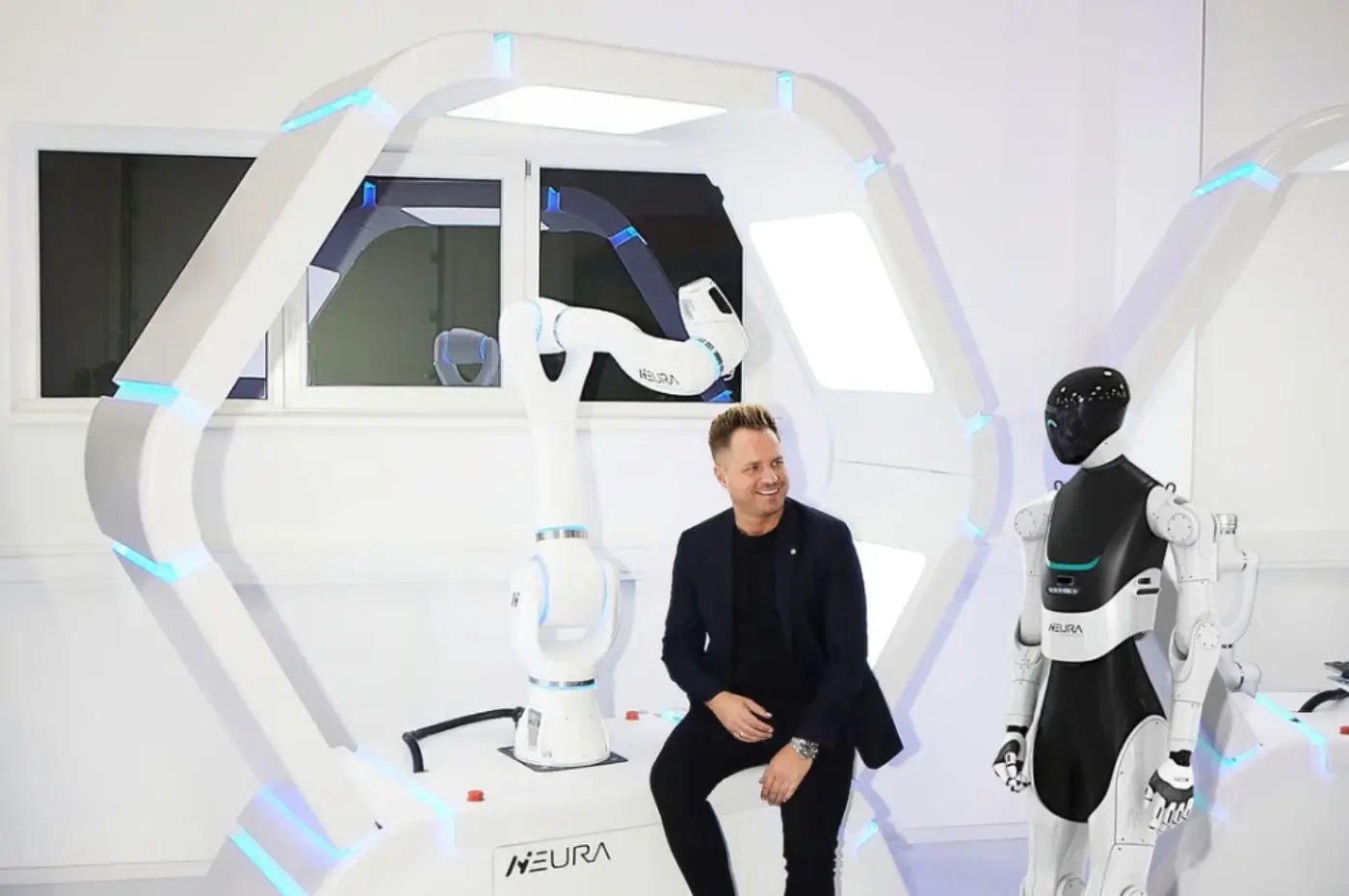

In January 2025, NEURA Robotics — the German cognitive and humanoid robotics pioneer — made headlines across Europe when it secured a €120 million Series B funding round. That investment, led by Lingotto Investment Management alongside a cohort of major backers, put NEURA on the map as one of the continent’s most exciting robotics innovators and underscored the rapid rise of AI‑powered physical machines that can work alongside humans.
With robotics widely predicted to be “bigger than the smartphone era,” NEURA’s success is not just a singular milestone but a bellwether for a fresh wave of funding, innovation, and ambition across the tech startup landscape.
In this clear, engaging, and professional exploration, we’ll unpack the broader context of startup funding in 2025 — especially in AI, robotics, and adjacent tech — and identify which companies are most likely to follow NEURA’s path to breakthrough success.
1. The New Era of AI and Robotics Investment
2025 was a watershed year in startup fundraising globally, with venture capital pouring heavily into AI‑centric technologies, from generative models and neuroscience interfaces to robotics and automation platforms. Across the year, AI captured a disproportionate share of VC deal value, outperforming many traditional tech sectors and indicating a sustained investor appetite for capital‑intensive innovation.
NEURA’s funding reflects this trend. Unlike many AI startups that focus on software alone, NEURA’s cognitive and humanoid robots bridge software and hardware, positioning the company at the crossroads of industrial automation, human‑robot collaboration, and next‑generation workplace augmentation.
But NEURA is not alone. Several startups worldwide are attracting major capital and attention — and they suggest where venture capital might flow next.
2. Generative AI and Foundation Tech: The Big Bet Beyond Robotics
The AI funding boom of 2025 was headed by mammoth rounds backing platform and foundation model companies. While NEURA represents the physical AI frontier, the software side continues to generate headline‑grabbing deals that will influence the entire ecosystem.
Thinking Machines Lab — an AI company founded in 2025 by former OpenAI CTO Mira Murati — reportedly raised $2 billion at a $12 billion valuation in its early funding, supported by investors including Nvidia, AMD, and Cisco. Such a round places this startup on par with some of the best‑funded AI newcomers in the world.
Similarly, deals with Anthropic and other major AI labs have reached staggering sizes — including rounds that could total tens of billions of dollars, marking generative AI as a core pillar of global tech investment strategy.
These software‑centric successes are vital context: they show that capital concentration isn’t limited to robotics alone; rather, robotics startups like NEURA benefit from a funding climate that prizes deep, high‑impact AI innovation.
3. Next Generation Robotics: Who’s Rising Behind NEURA
NEURA’s success spotlighted humanoid robots as a frontier tech category. But other robotics startups are already building momentum — and some have raised substantial funding rounds of their own.
Apptronik — Humanoid Robotics
Longer established than NEURA, Apptronik made waves in early 2025 when it secured $350 million in Series A funding focused on humanoid robotic platforms capable of performing thousands of tasks with broad industrial utility.
This funding emphasizes that humanoid robotics is becoming a distinct investment category, beyond traditional factory automation, and that venture capital firms are willing to commit to capital‑intensive robotics hardware at scale.
1X Technologies — Robots for the Home
While Apptronik’s robots are industrial, 1X Technologies is pushing toward home and consumer humanoids. With prior funding rounds totaling over $100 million and ambitions to raise more than $1 billion for expanded development, 1X reflects a parallel approach to what NEURA is doing in Europe but with a U.S.–based, consumer‑oriented twist.
In the coming years, as these robots become more capable and production‑ready, companies like 1X could attract NEURA‑like rounds or even larger strategic investments, including partnerships with major chip and cloud providers.
Skild AI — General Purpose Robotics Intelligence
Another company making headlines is Skild AI, which recently raised an eye‑watering $1.4 billion to build what it calls an “omni‑bodied brain” — a unified intelligence layer designed to control a wide variety of robotic platforms.
This approach signals a growing belief that robotics will be most powerful when integrated with sophisticated machine reasoning — a theme that aligns closely with NEURA’s emphasis on cognitive capabilities.
4. AI Tools and Platforms: Supporting the Next Wave of Innovation
The startups that follow NEURA won’t just be hardware builders. Many will be platform companies and tools that support AI development, scaling, and integration, representing the less‑glamorous but financially critical layer of the tech stack.
Higgsfield — AI Video Generation
Although not a robotics company, Higgsfield made major waves by securing $80 million in funding and achieving a $1.3 billion valuation thanks to its AI video generation platform. This shows that vision and content technologies are also hot investment categories.
Startups like Higgsfield demonstrate a trend: specialized AI tools for creative and enterprise markets are gathering strong backing — and they are often the companies that drive broader on‑ramp adoption for AI capabilities across industry.

Emergent — AI for Code Creation
Another standout is Emergent, a “vibe coding” startup that raised $70 million in Series B funding to enable people without programming experience to generate sophisticated apps using AI. Its rapid user growth and monetization trajectory highlight that AI for software generation will remain a capital‑rich niche.
These platform and tooling startups are natural ecosystem partners for hardware innovators like NEURA, providing backend intelligence, developer productivity, and multi‑modal AI support that broaden robotics’ real‑world applicability.
5. Biotech, Interfaces, and Beyond: The Wider Horizon
As investors look for winners in 2025 and beyond, the fallout from NEURA’s success suggests a few other adjacent areas worth watching:
- Brain–Machine Interfaces: Investment in companies like Merge Labs — cofounded by Sam Altman — signals VC interest in neurotech and AI integration at the biological level.
- Healthcare AI Platforms: With biotech AI funding still robust, startups combining AI with medical diagnostics, drug discovery, and clinical workflows look like fertile follow‑ons to broader AI investment themes.
- Cybersecurity and Infrastructure: AI security platforms and developer tools — although smaller rounds in some cases — are critical to protecting and scaling AI deployment globally.
These verticals often influence where robotics and autonomy investment flows, because challenges like safety, human‑robot trust, and interoperability remain complex and capital intensive.
6. What Makes a “Follow‑On” Startup? Core Traits Investors Are Betting On
NEURA’s success — and the broader investments listed above — point to a few repeated investor criteria:
1. Deep Tech Differentiation
Startups with a unique architecture or technical edge — whether it’s cognition in robots or reasoning engines for AI video — tend to attract larger, later‑stage capital.
2. Real‑World Utility
Investors prioritize companies that are not just theoretical or demo‑focused, but have clear paths to commercial traction and revenue. The most successful rounds in 2025 emphasize deployable solutions.
3. Scalable Platforms
Companies that unlock broader ecosystems — like AI tooling, productivity stacks, or robotics control frameworks — are more likely to land mega rounds.
4. Human‑Centric Integration
Whether it’s humanoid robots designed to collaborate with people or AI systems aimed at enhancing human productivity, this human‑centric angle resonates with funders — just as NEURA’s cognitive focus does.
Together, these traits form the blueprint for the next generation of startups following in NEURA’s footsteps.
Conclusion: The NEURA Effect and the Next Wave of Winners
NEURA’s €120 million funding success was not an isolated act of investor confidence, but part of a broader capital tide rising behind AI, robotics, and interdisciplinary tech in 2025. Whether it’s humanoid hardware builders, foundational AI labs, scaled tool startups, or neurotech innovators, 2025’s funding landscape will spawn multiple breakout stars.
The startups most likely to replicate NEURA’s journey share a blend of technical ambition, practical commercial strategy, and a vision for how AI will reshape human work and life. As capital flows continue into 2026 and beyond, look to companies that can deliver both cutting‑edge innovation and tangible real‑world impact.