








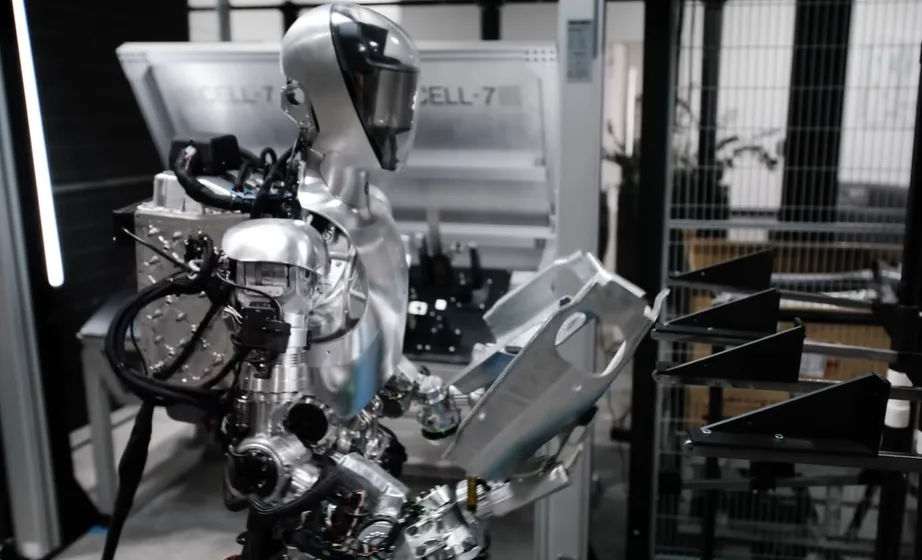

Introduction: A New Kind of Worker Arrives
For decades, industrial robots have been a defining feature of modern manufacturing. Massive robotic arms weld car frames with perfect precision, automated systems assemble electronics faster than any human, and conveyor belts carry materials through sprawling factories operating around the clock.
Yet despite these advances, most factories still rely heavily on human workers.
Why? Because traditional industrial robots are extremely specialized. They are designed to perform a single task repeatedly in a controlled environment. If the production process changes—even slightly—the robot often needs to be reprogrammed, relocated, or replaced.
Humans, on the other hand, are adaptable.
We can move through complex environments, manipulate objects of different shapes and sizes, and switch tasks quickly. This flexibility is why humans remain essential in many parts of manufacturing.
Today, a new generation of machines is emerging that aims to combine robotic precision with human-like adaptability: humanoid robots.
Companies such as Tesla, Figure AI, Agility Robotics, and Boston Dynamics are developing robots with two arms, two legs, and the ability to move through environments built for people.
These machines are not simply advanced automation tools—they are designed to become robot co-workers.
As manufacturing faces rising labor shortages, increasing production complexity, and pressure for greater efficiency, humanoid robots may soon become a common sight on factory floors.
Why Factories Need Humanoid Robots
The Limits of Traditional Industrial Robots
Industrial robots have been used in manufacturing since the 1960s. Over time they have become faster, more precise, and more reliable.
However, they also come with several limitations:
1. Lack of flexibility
Most industrial robots perform only one specific task. A robotic arm designed for welding cannot easily be repurposed for assembly or inspection.
2. Fixed workspaces
Traditional robots usually operate within cages or restricted areas to ensure worker safety. This separation limits collaboration between humans and machines.
3. Expensive reconfiguration
When production lines change—a common occurrence in modern manufacturing—factories may need to redesign entire robotic systems.
Humanoid robots aim to solve these problems by bringing flexibility into automation.
Designed for Human Environments
Factories today are built around human workers.
Doorways, ladders, workstations, tools, and storage systems are designed for the human body. A humanoid robot can operate in these environments without requiring major redesign.
Instead of rebuilding factories for robots, manufacturers can introduce robots that adapt to the existing workplace.
This idea is central to the vision behind robots like Optimus and Digit.
Key Tasks Humanoid Robots Can Perform
Humanoid robots are not intended to replace every job in manufacturing. Instead, they are particularly suited to tasks that are:
- repetitive
- physically demanding
- potentially dangerous
- difficult to automate with traditional robots
Here are some of the most promising applications.
Material Handling
Factories require constant movement of parts and components between stations.
Humanoid robots can:
- carry boxes and tools
- load parts onto conveyor belts
- move materials between workstations
Unlike wheeled robots that rely on fixed routes, humanoid robots can navigate complex spaces, climb stairs, and access areas designed for people.
Assembly Assistance
Many manufacturing processes require delicate manipulation.
Human workers perform tasks such as:
- fastening components
- aligning parts
- installing small pieces
Humanoid robots equipped with advanced vision systems and dexterous hands may soon assist with these operations.
Instead of fully automated assembly lines, factories could use human-robot collaborative teams.
Quality Inspection
Another key manufacturing task is quality control.
Humanoid robots equipped with sensors and cameras can:
- inspect products
- detect defects
- collect production data
These robots could operate continuously, improving consistency and reducing error rates.
Labor Shortages and the Manufacturing Workforce
One of the most important drivers behind humanoid robot development is the global shortage of manufacturing workers.
Many industrialized countries face:
- aging populations
- declining interest in factory work
- rising labor costs
Manufacturers increasingly struggle to recruit and retain workers for physically demanding jobs.
In the United States, for example, millions of manufacturing positions are projected to remain unfilled over the coming decade.
Humanoid robots offer a potential solution by augmenting the workforce rather than replacing it entirely.
Robots could handle the most physically demanding tasks while human workers focus on supervision, problem-solving, and higher-level operations.
Case Studies: Early Industry Experiments
Tesla’s Vision for Robot Workers
Electric vehicle manufacturer Tesla has become one of the most prominent companies pursuing humanoid robotics.
Its robot, Optimus, is designed to perform tasks inside Tesla factories.
The company envisions robots capable of:
- moving components across assembly lines
- assisting with repetitive tasks
- performing logistics operations
While still in development, Tesla believes humanoid robots could eventually become a major part of manufacturing.
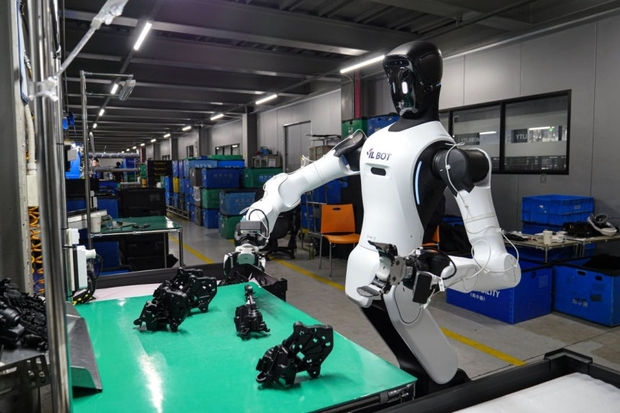
Warehouse Integration
Another example comes from Agility Robotics, which developed the humanoid robot Digit.
Digit has been tested in warehouse environments where it can:
- pick up boxes
- place items on shelves
- assist with logistics operations
Although warehouses differ from factories, many of the same capabilities apply to manufacturing settings.
The Technology Behind Humanoid Robots
Several technological breakthroughs are making humanoid robots possible.
Advanced Artificial Intelligence
Modern robots rely heavily on AI systems capable of:
- visual perception
- motion planning
- object recognition
These systems allow robots to understand their environment and interact with objects.
Improved Actuators
Actuators are the motors that power robotic movement.
Recent advances have made actuators:
- stronger
- more energy efficient
- more compact
This allows humanoid robots to move with greater speed and precision.
Sensor Fusion
Humanoid robots combine multiple sensors including:
- cameras
- lidar
- force sensors
- tactile sensors
Together these sensors enable robots to interact with the physical world in more sophisticated ways.
Challenges Facing Humanoid Robots in Manufacturing
Despite rapid progress, humanoid robots still face significant challenges before widespread adoption.
Cost
Building a humanoid robot remains extremely expensive.
Early models may cost hundreds of thousands of dollars, limiting their accessibility.
However, as production scales up, prices are expected to decline.
Reliability
Factories require machines that operate reliably for thousands of hours.
Humanoid robots must prove they can handle continuous industrial use.
Safety
Working alongside humans introduces safety concerns.
Robots must be able to detect people and react instantly to avoid accidents.
The Future of Human–Robot Collaboration
Rather than replacing human workers, humanoid robots may redefine the way factories operate.
Future manufacturing environments could feature:
- humans managing production strategy
- robots handling repetitive labor
- AI systems optimizing operations
This hybrid workforce could significantly improve productivity.
Workers may transition into roles such as:
- robot supervisors
- automation technicians
- data analysts
In this sense, humanoid robots may transform not only manufacturing technology but also the nature of industrial work.
Conclusion: The Rise of the Robot Co-Worker
Humanoid robots represent one of the most ambitious technological developments in modern automation.
By combining mobility, dexterity, and artificial intelligence, these machines aim to bridge the gap between traditional robotics and human labor.
Although widespread deployment is still several years away, early experiments already suggest a future where factories include both human workers and robotic colleagues.
The manufacturing floor of the future may look very different from today’s assembly lines.
Instead of rows of isolated machines performing single tasks, factories could become dynamic environments where humans and humanoid robots collaborate side by side.
In that world, the arrival of robot co-workers will not simply be a technological milestone—it will mark a profound shift in how goods are produced and how industries operate.
Discussion about this post