








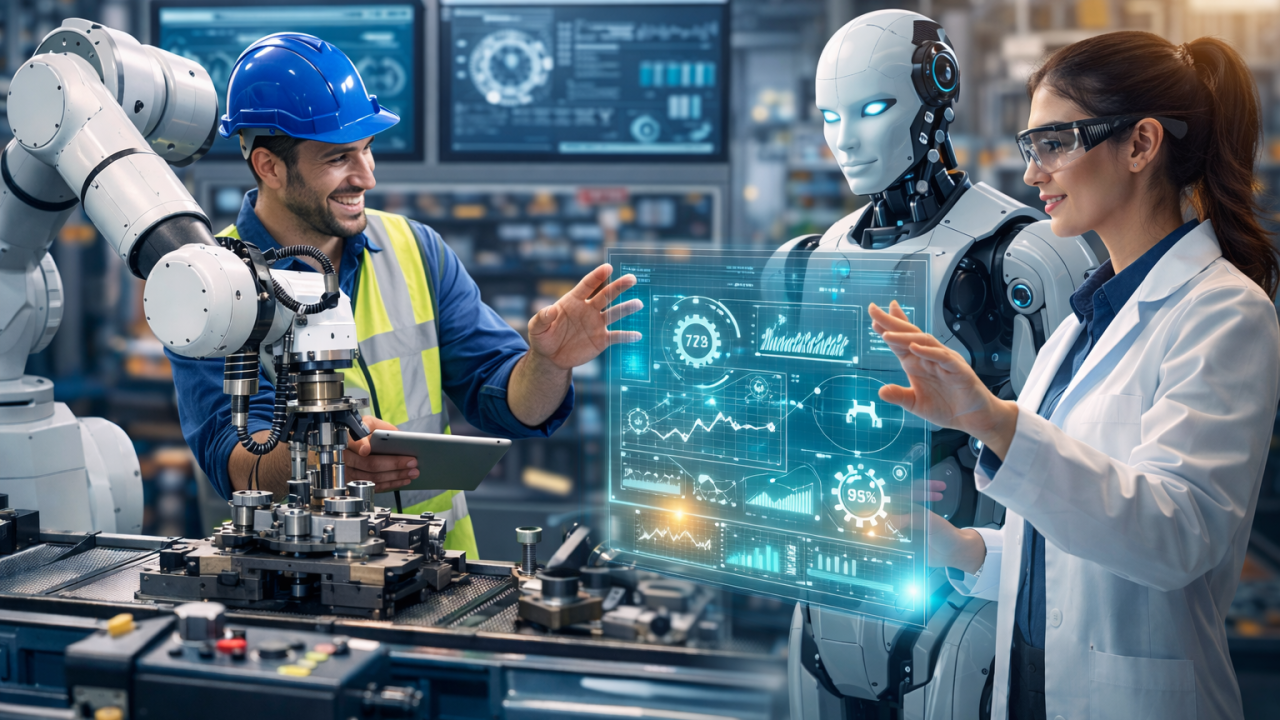

Executive Overview: From Automation to Human-Like Adaptability
For decades, industrial automation has relied heavily on fixed robotic arms, conveyor systems, and specialized machinery designed for repetitive, high-volume tasks. While these technologies have dramatically increased efficiency, they come with inherent limitations: rigidity, high reconfiguration costs, and a lack of adaptability in dynamic environments.
Humanoid robots represent the next evolutionary step in industrial automation. Unlike traditional robots, humanoid systems are designed to operate in environments built for humans. With two arms, dexterous hands, bipedal or hybrid mobility, and advanced AI-driven perception systems, they can perform a wide range of tasks without requiring extensive changes to existing infrastructure.
This shift is not merely technological—it is strategic. As global supply chains become more volatile and demand for customization increases, manufacturers are seeking solutions that offer both efficiency and flexibility. Humanoid robots are uniquely positioned to meet these demands.
This article explores how humanoid robots are transforming industrial and manufacturing sectors, examining real-world applications, economic implications, workforce impacts, and future trajectories.
1. The Limitations of Traditional Industrial Robotics
Before understanding the value of humanoid robots, it is essential to examine the constraints of current automation systems.
1.1 Fixed Functionality and Lack of Flexibility
Traditional industrial robots are typically designed for specific tasks such as welding, painting, or assembly. Reprogramming or reconfiguring these systems can be:
- Time-consuming
- Expensive
- Technically complex
This makes them less suitable for industries requiring rapid product changes or customization.
1.2 Infrastructure Dependency
Most industrial robots operate in highly controlled environments:
- Fixed positions
- Safety cages
- Predefined workflows
Any deviation from these conditions can disrupt operations, limiting scalability.
1.3 Human-Robot Separation
Safety concerns often require physical separation between robots and human workers, reducing opportunities for collaboration and efficiency.
2. What Makes Humanoid Robots Different?
Humanoid robots introduce a fundamentally different paradigm in industrial automation.
2.1 Human-Centric Design
Their physical structure allows them to:
- Use tools designed for humans
- Navigate stairs, corridors, and uneven terrain
- Operate in existing workspaces without redesign
2.2 Advanced Perception and AI
Equipped with:
- Computer vision
- Sensor fusion
- Machine learning algorithms
humanoid robots can understand and adapt to their environment in real time.
2.3 Multi-Task Capability
Unlike single-purpose machines, humanoid robots can perform multiple tasks, such as:
- Picking and packing
- Assembly
- Inspection
- Maintenance
This versatility significantly increases their value proposition.
3. Key Applications in Manufacturing
3.1 Assembly Line Operations
Humanoid robots can work alongside humans on assembly lines, handling tasks that require:
- Precision
- Repetition
- Dexterity
For example, they can assemble small components, fasten screws, or connect wiring systems.
3.2 Material Handling and Logistics
In warehouses and factories, humanoid robots can:
- Transport materials between stations
- Load and unload goods
- Organize inventory
Their ability to move freely within human-designed spaces eliminates the need for specialized transport systems.
3.3 Quality Inspection
Using advanced vision systems, humanoid robots can:
- Detect defects
- Measure tolerances
- Ensure product consistency
They can operate continuously, improving quality control processes.
3.4 Maintenance and Repair
Humanoid robots can perform routine maintenance tasks, such as:
- Inspecting machinery
- Replacing components
- Diagnosing issues
This reduces downtime and extends equipment lifespan.
4. Case Studies: Real-World Implementations
4.1 Automotive Manufacturing
Automotive companies are among the earliest adopters of humanoid robots. These robots are being tested for:
- Final assembly tasks
- Interior installations
- Quality checks
Their flexibility allows manufacturers to adapt quickly to new vehicle designs.
4.2 Electronics Production
In electronics manufacturing, where precision is critical, humanoid robots are used for:
- Circuit board assembly
- Component placement
- Testing and inspection
Their steady movements and high accuracy reduce error rates.
4.3 E-commerce Warehousing
Major e-commerce companies are exploring humanoid robots for warehouse operations, including:
- Order picking
- Packaging
- Sorting
This is particularly valuable during peak demand periods when labor shortages are common.
5. Economic Impact and Business Value
5.1 Cost-Benefit Analysis
While humanoid robots require significant upfront investment, their long-term benefits include:
- Reduced labor costs
- Increased productivity
- Lower error rates
- Greater operational flexibility
5.2 Scalability
Humanoid robots can be deployed incrementally, allowing businesses to scale operations without major infrastructure changes.
5.3 Competitive Advantage
Companies that adopt humanoid robotics early can gain a significant edge by:
- Reducing time-to-market
- Enhancing product quality
- Improving responsiveness to market changes
6. Workforce Transformation
6.1 Redefining Human Roles
Rather than replacing workers, humanoid robots are reshaping job roles. Humans can focus on:
- Complex problem-solving
- Creative tasks
- Supervisory functions
6.2 Upskilling and Reskilling
The integration of humanoid robots creates demand for new skills, such as:
- Robot programming
- System maintenance
- Data analysis
6.3 Human-Robot Collaboration
Collaborative environments, where humans and robots work side by side, are becoming increasingly common. This requires:
- New safety standards
- Improved interface design
- Trust-building measures
7. Challenges and Barriers to Adoption
7.1 Technical Challenges
- Battery life limitations
- Dexterity and grip precision
- Real-time decision-making in complex environments
7.2 High Initial Costs
The cost of development, deployment, and maintenance remains a significant barrier for many companies.
7.3 Regulatory and Safety Concerns
Ensuring safe interaction between humans and humanoid robots is critical, requiring:
- Robust safety systems
- Compliance with regulations
- Continuous monitoring
8. The Role of AI and Emerging Technologies
Humanoid robots rely heavily on advancements in:
8.1 Artificial Intelligence
AI enables robots to:
- Learn from experience
- Adapt to new tasks
- Improve performance over time
8.2 Edge Computing
Processing data locally allows for:
- Faster decision-making
- Reduced latency
- Greater reliability
8.3 Connectivity (5G and Beyond)
High-speed connectivity enables:
- Real-time data sharing
- Remote monitoring
- Cloud-based learning
9. Future Trends: Toward Fully Adaptive Factories
9.1 Lights-Out Manufacturing
Factories of the future may operate with minimal human presence, relying heavily on humanoid robots for end-to-end processes.
9.2 Mass Customization
Humanoid robots enable manufacturers to produce customized products at scale without sacrificing efficiency.
9.3 Global Supply Chain Resilience
By reducing dependence on human labor and enabling localized production, humanoid robots can strengthen supply chain resilience.
10. Strategic Considerations for Businesses
Companies considering humanoid robotics should focus on:
- Identifying high-impact use cases
- Starting with pilot programs
- Investing in workforce training
- Building partnerships with technology providers
A phased approach can help mitigate risks and maximize returns.
Conclusion
Humanoid robots are poised to redefine industrial and manufacturing sectors by bridging the gap between human adaptability and machine efficiency. Their ability to operate in human-designed environments, perform diverse tasks, and collaborate with workers makes them a powerful tool for modern industries.
While challenges remain, the trajectory is clear: humanoid robots will play a central role in the factories of the future. Companies that embrace this transformation early will be better positioned to navigate an increasingly complex and competitive global landscape.
Discussion about this post