








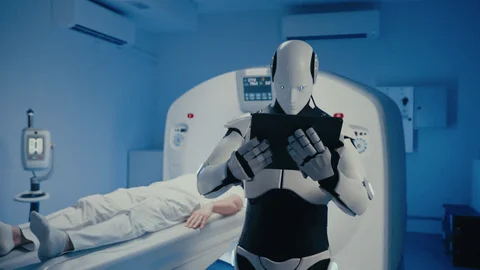

Three Rooms, Three Lives
In a care facility on the outskirts of a major city, three doors sit along the same hallway.
Behind each door is a different story.
And in each room, a humanoid robot is present—but not in the same way.
Room 101: Assistance
Mr. Tanaka is 78 years old.
He lives alone in a small, carefully organized space within the facility. Every object has a place. Every routine is fixed.
At 9:00 AM, the robot enters.
“Good morning. It’s time for your medication.”
It doesn’t remind him once.
It waits.
Watches.
Confirms.
If he forgets, it repeats. If he hesitates, it adjusts tone.
This is not conversation.
This is compliance support.
What Robots Do Well Here
- Medication reminders with near-perfect consistency
- Fall detection and immediate alerts
- Routine monitoring without fatigue
For patients like Mr. Tanaka, the robot is not a companion.
It is a safety system with a body.
Room 204: Interaction
Ms. Liu is 82.
She doesn’t need much physical assistance.
What she needs is someone to talk to.
The robot sits across from her.
“Would you like to continue yesterday’s story?”
She smiles.
They begin again.
The Conversation Isn’t Real—But It Works
The robot:
- Remembers past conversations
- Adapts tone and pacing
- Asks follow-up questions
It does not feel emotions.
But it simulates attention.
And for Ms. Liu, that’s enough.
The Ethical Question
Is this companionship?
Or imitation?
And does the difference matter—if the outcome is reduced loneliness?
Room 312: Resistance
Mr. Park is 69.
He refuses to use the robot.
“I don’t want a machine telling me what to do,” he says.
When the robot enters, he ignores it.
When it speaks, he turns away.
When it offers help, he declines.
Not Everyone Accepts the System
For some patients, humanoid robots represent:
- Loss of independence
- Replacement of human care
- An unwanted intrusion
Adoption is not universal.
And it never will be.
The Care Gap: Why Robots Are Being Deployed
Behind these three rooms lies a larger issue:
There are not enough caregivers.
Globally, aging populations are increasing faster than the workforce that supports them.
Care systems are under pressure.
Costs are rising.
Burnout is common.
Humanoid robots are being introduced not because they are perfect—
but because the alternative is insufficient care.
What Robots Actually Do in Healthcare
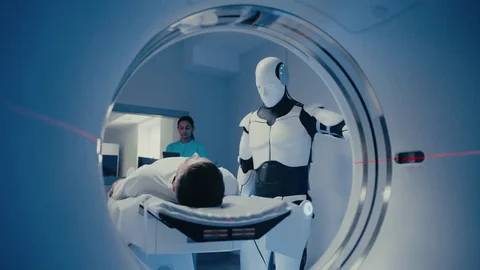
Despite the hype, humanoid robots are not replacing doctors or nurses.
They are filling very specific roles:
1. Routine Monitoring
- Vital checks
- Behavioral tracking
- Daily activity logging
2. Physical Assistance
- Helping patients stand or move
- Fetching objects
- Supporting mobility
3. Cognitive Support
- Memory prompts
- Schedule reminders
- Simple engagement
4. Emotional Simulation
- Conversation
- Presence
- Interaction patterns
What They Cannot Do
This is just as important.
Humanoid robots still struggle with:
- Complex medical decision-making
- Emotional nuance
- Unpredictable patient behavior
- Ethical judgment
In critical situations, human caregivers remain essential.
The Caregiver Perspective
For staff, the impact is immediate.
A nurse managing 12 patients can now rely on robotic support for:
- Routine check-ins
- Night monitoring
- Non-critical tasks
This reduces workload.
But it also changes the nature of the job.
From Care to Coordination
Instead of constant physical presence, caregivers become:
- Supervisors
- Decision-makers
- Exception handlers
The job becomes less physically demanding—
but more cognitively complex.
The Family Perspective
Families often have mixed reactions.
Relief
- More consistent monitoring
- Increased safety
- Reduced burden on family members
Concern
- Less human interaction
- Emotional substitution
- Over-reliance on machines
A Common Question
“Is my parent being cared for—or managed?”
The Emotional Reality
Perhaps the most surprising aspect of humanoid robots in care is not what they do—
but how people respond to them.
Patients Adapt Quickly
Even those initially skeptical often begin to:
- Respond to prompts
- Engage in conversation
- Accept assistance
Not because they believe the robot is human—
but because it is consistently present.
Consistency Builds Trust
Humans are inconsistent.
Robots are not.
And in care environments, consistency matters.
The Risk of Substitution
There is a concern that robots may not just assist care—
but replace parts of it.
The Slippery Shift
- From assisting nurses
- To reducing nurse workloads
- To reducing nurse numbers
This progression is not guaranteed.
But it is possible.
Regulation and Oversight
Healthcare is one of the most sensitive domains for robotics.
As a result, deployment is often tightly controlled.
Key areas of regulation include:
- Patient safety
- Data privacy
- System reliability
- Human oversight requirements
But policies vary widely by region.
And technology is moving faster than regulation.
A System Under Transition
Humanoid robots are not transforming healthcare overnight.
They are entering gradually.
Quietly.
Room by room.
Patient by patient.
Back to the Three Rooms
Mr. Tanaka takes his medication.
Ms. Liu continues her conversation.
Mr. Park closes his door.
Three different responses to the same technology.
Conclusion
Humanoid robots in healthcare are not a simple solution.
They are a response to a complex problem.
They bring:
- Efficiency
- Consistency
- Scalability
But also:
- Ethical questions
- Emotional ambiguity
- Social tension
In the end, the question is not whether robots can care for people.
It is whether we are comfortable redefining what care means.
And whether, in solving one problem—
we create another.