










Introduction: From AI Race to Physical Intelligence
For the past several years, the global technology narrative has been dominated by a single theme: artificial intelligence.
Nations competed over:
- large language models
- semiconductor supply chains
- cloud infrastructure
- data dominance
But in 2026, a new layer has emerged—one that extends beyond software and into the physical world.
The race is no longer just about intelligence.
It is about embodiment.
Humanoid robots—machines capable of performing human-like tasks in real-world environments—are rapidly becoming the next frontier of technological competition. And unlike previous waves of automation, this one carries implications not only for productivity, but for geopolitical power.
The shift is subtle but profound:
AI is no longer confined to screens.
It is entering factories, warehouses, and eventually homes.
And in doing so, it is reshaping the balance of global power.
Why Humanoid Robots Matter Strategically
At first glance, humanoid robots may appear to be just another technological curiosity. But their strategic significance lies in three core capabilities:
1. Labor Replacement at Scale
Unlike traditional automation systems, humanoid robots are designed to operate in environments built for humans.
This means they can:
- use existing tools
- navigate existing infrastructure
- replace human labor without requiring redesign
In economic terms, this dramatically lowers the barrier to automation.
Countries that successfully deploy humanoid robots at scale could:
- offset declining populations
- reduce reliance on migrant labor
- maintain industrial output
2. Manufacturing Sovereignty
Modern geopolitics is increasingly shaped by supply chains.
From semiconductors to energy, nations are seeking greater control over production capacity.
Humanoid robots introduce a new variable:
fully automated, flexible manufacturing systems
Instead of relying on large human workforces, factories could operate with:
- smaller human teams
- robot labor fleets
- AI-driven coordination systems
This could allow countries to:
- reshore manufacturing
- reduce geopolitical dependencies
- increase resilience during crises
3. Dual-Use Potential
Like many advanced technologies, humanoid robots have both civilian and military applications.
While current development is focused on:
- logistics
- manufacturing
- service industries
The same capabilities—mobility, manipulation, autonomy—could eventually be adapted for:
- defense logistics
- disaster response
- surveillance operations
This dual-use nature makes humanoid robotics not just an economic asset, but a strategic one.
The United States: Innovation and Platform Thinking
The United States enters the humanoid robotics race with a familiar advantage: innovation ecosystems.
Key players include:
- Tesla
- Boston Dynamics
- Figure AI
- major AI labs integrating robotics
The American approach is characterized by:
Platform Strategy
Rather than focusing solely on hardware, U.S. companies are building integrated ecosystems:
- AI models
- simulation environments
- developer platforms
- data pipelines
The goal is not just to build robots—but to build the operating systems that power them.
Software-First Mentality
U.S. firms increasingly treat robots as:
“AI systems with bodies”
This perspective prioritizes:
- learning capability
- generalization
- adaptability
Rather than optimizing for specific tasks, the focus is on creating robots that can learn new ones.
Venture-Driven Speed
The American robotics sector is fueled by:
- venture capital
- startup ecosystems
- rapid iteration cycles
This enables:
- high-risk experimentation
- fast scaling of successful models
- aggressive competition
However, this approach also comes with challenges:
- high costs
- fragmented manufacturing
- dependence on global supply chains
China: Scale, Integration, and Industrial Policy
If the U.S. represents innovation, China represents execution.
China’s humanoid robotics strategy is deeply integrated into its broader industrial policy.
Key characteristics include:
State-Backed Investment
Massive funding is being directed into:
- robotics companies
- component manufacturing
- AI integration
This enables long-term development that is less dependent on short-term profitability.
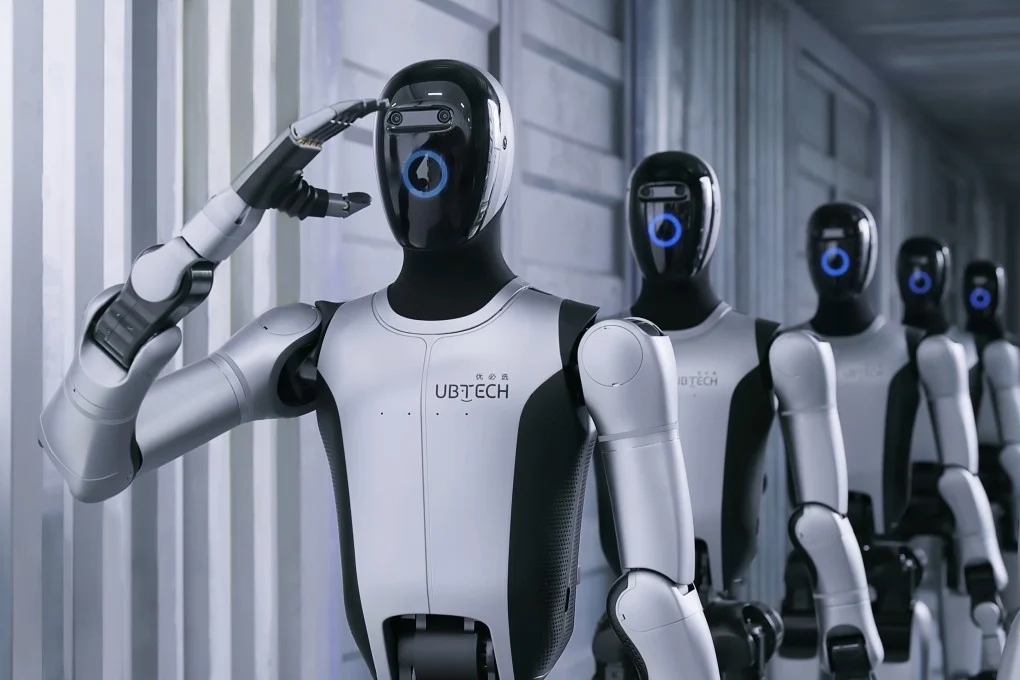
Manufacturing Ecosystem Advantage
China already dominates global manufacturing.
This provides a critical advantage:
- access to supply chains
- cost-efficient production
- rapid prototyping capabilities
In robotics, this translates into:
- faster iteration cycles
- lower production costs
- quicker deployment
Deployment-First Strategy
While Western companies often prioritize perfection, Chinese firms emphasize:
deploy early, improve later
Robots are introduced into real environments sooner, allowing:
- faster data collection
- real-world training
- continuous improvement
This approach may sacrifice initial polish—but accelerates overall progress.
Europe and Others: Between Regulation and Innovation
Europe’s role in the humanoid robotics race is more complex.
Strengths include:
- advanced engineering
- strong research institutions
- industrial automation expertise
However, challenges remain:
- slower commercialization
- stricter regulatory environments
- fragmented markets
European efforts tend to focus on:
- safety standards
- ethical frameworks
- collaborative robotics
While this may limit short-term speed, it could shape long-term global norms.
The Supply Chain Battlefield
Behind every humanoid robot lies a complex supply chain.
Critical components include:
- actuators
- sensors
- semiconductors
- batteries
- precision gear systems
Control over these components is becoming increasingly important.
For example:
- advanced chips are still dominated by a few global players
- high-precision components require specialized manufacturing
- battery technology remains a key bottleneck
This creates interdependencies that complicate the idea of technological independence.
The humanoid robotics race, therefore, is not just about robots—it is about everything behind them.
AI as the Deciding Factor
While hardware matters, the ultimate differentiator may be AI.
Recent advances in:
- multimodal models
- reinforcement learning
- simulation-based training
are enabling robots to:
- understand environments
- learn new tasks
- adapt in real time
The country or company that achieves:
general-purpose physical intelligence
will hold a निर्णctive advantage.
Because at that point, robots are no longer tools.
They become autonomous workers.
Risks of a Robotics Divide
As with previous technological revolutions, the rise of humanoid robots could create new inequalities.
Countries that lead in robotics may gain:
- economic dominance
- manufacturing power
- technological leverage
Those that lag behind may face:
- job displacement without replacement
- dependence on foreign technology
- reduced competitiveness
This could lead to a global robotics divide, similar to the digital divide of previous decades—but potentially more consequential.
Beyond Competition: The Case for Cooperation
Despite competitive pressures, there are areas where cooperation remains essential:
- safety standards
- ethical guidelines
- disaster response applications
- global supply chain stability
Humanoid robots will increasingly operate in shared environments, making:
- interoperability
- safety protocols
- regulatory alignment
critical for global stability.
Conclusion: The Beginning of the Physical AI Era
The emergence of humanoid robots marks a turning point in technological history.
For the first time:
- intelligence is becoming physical
- AI is entering the real world
- machines are beginning to perform human labor
This transformation is not just economic.
It is geopolitical.
The humanoid arms race is not about who builds the most impressive robot.
It is about who builds:
- the most scalable systems
- the most intelligent machines
- the most resilient ecosystems
Because in the coming decades, power may not be measured solely by data or computation—
but by the ability to deploy intelligence into the physical world.
Discussion about this post