








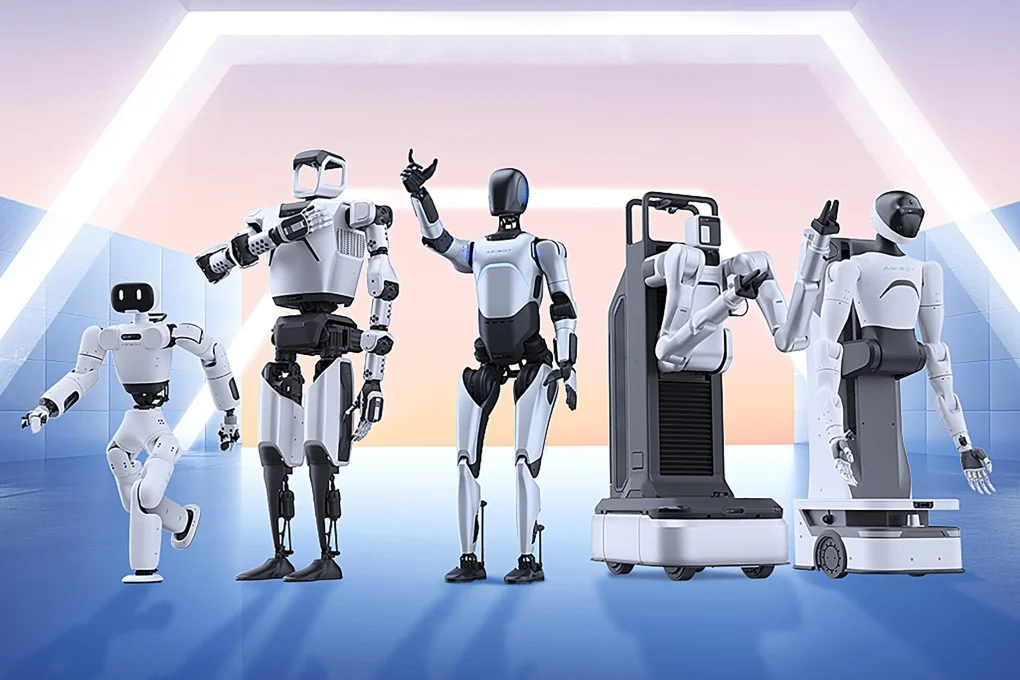

Introduction: The End of the Prototype Era
For decades, humanoid robots existed largely as technological theater—machines designed to impress rather than to work. From carefully choreographed demos to viral videos of robots dancing, flipping, and mimicking human gestures, the field of humanoid robotics has long been associated with spectacle rather than substance.
But 2026 marks a turning point.
Across factories, research labs, and AI companies, humanoid robots are quietly transitioning from experimental prototypes to deployed industrial systems. The shift is not symbolic—it is structural. Robots are now being manufactured, sold, integrated, and trained at scale.
At the center of this transformation are several converging developments:
- The commercialization of humanoid hardware
- The integration of foundation AI models into robotics
- Massive capital investment from both governments and corporations
- And a growing global labor shortage pushing automation forward
Recent announcements and deployments—from Boston Dynamics’ Atlas entering production to Tesla’s Optimus scaling manufacturing—suggest that humanoid robots are no longer a distant future. They are becoming part of the present industrial landscape.
From Backflips to Assembly Lines
Perhaps the clearest symbol of this shift is the evolution of Boston Dynamics’ Atlas robot.
Once famous for viral videos of parkour and backflips, Atlas has undergone a fundamental transformation. At CES 2026, the company unveiled a fully electric, production-ready version designed not for demonstration—but for deployment.
This is not a minor upgrade. It represents a philosophical shift.
Instead of optimizing for agility alone, the new Atlas is built for:
- repetitive industrial tasks
- material handling
- automotive assembly support
All 2026 production units are already committed to industrial partners, including Hyundai and Google DeepMind.
In other words: the robot is no longer waiting for a use case. The use case already exists.
The implications are profound. For the first time, a humanoid robot is not just capable of working—it is being deployed into real production environments where failure has real cost.
Tesla’s Optimus: Scaling the Humanoid Vision
While Boston Dynamics represents engineering excellence, Tesla represents something else entirely: scale.
Tesla’s humanoid robot, Optimus, is being developed not just as a product—but as a mass-produced platform. In early 2026, the company began ramping production of its latest generation, aiming to deploy thousands of units internally before expanding outward.
The strategy is clear:
- Use Tesla’s manufacturing expertise
- Leverage existing AI infrastructure (from autonomous driving)
- Drive costs down to consumer-accessible levels
Elon Musk has repeatedly stated that Optimus could eventually cost around $20,000–$30,000—less than a car.
If achieved, this would fundamentally change the economics of labor.
Unlike Atlas, which is positioned as an enterprise-grade system, Optimus is designed to become a general-purpose labor unit—capable of performing tasks across factories, warehouses, and potentially even homes.
The contrast between the two approaches is striking:
| Company | Strategy |
|---|---|
| Boston Dynamics | High-performance industrial robots |
| Tesla | Mass-market, scalable humanoids |
Together, they define the emerging spectrum of the humanoid robotics industry.
China’s Robotics Acceleration
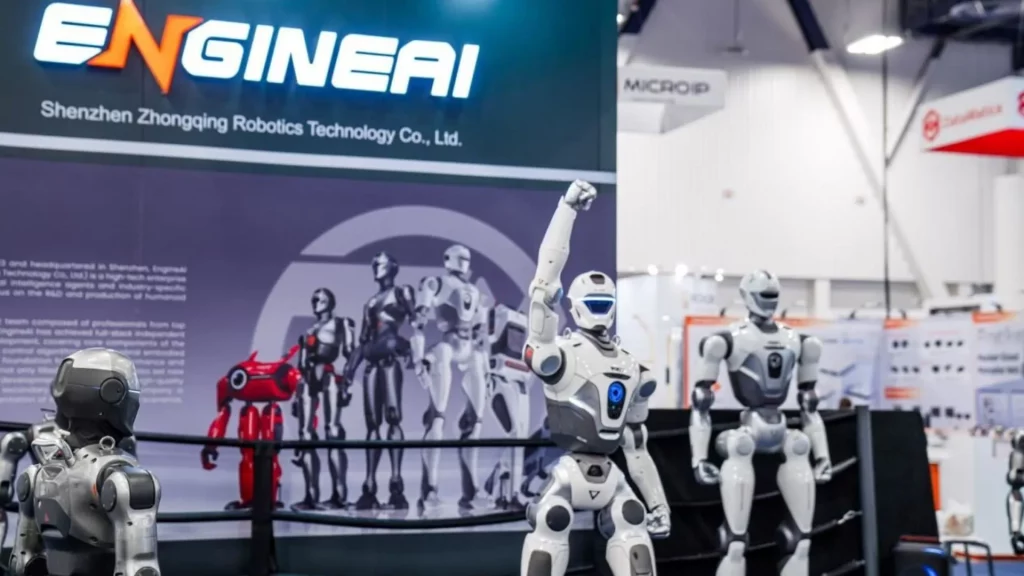
While U.S. companies dominate headlines, China is rapidly becoming the most aggressive player in humanoid robotics.
A recent investigation into China’s robotics sector reveals a massive, state-supported push to automate manufacturing using humanoid systems.
Key elements of China’s strategy include:
- A national fund exceeding £100 billion
- Local government incentives for robotics companies
- Integration of AI, vision-language models, and automation
- Large-scale data generation through teleoperation
Chinese firms such as Unitree and emerging startups are focusing on:
- lower-cost humanoid platforms
- rapid iteration cycles
- deployment in factories and retail environments
Unlike Western companies, which often emphasize technological breakthroughs, China’s approach is more pragmatic: deploy early, iterate quickly, and scale aggressively.
The result is a parallel ecosystem that could outpace competitors in adoption—even if not in raw technological sophistication.
The Role of AI: From Motion to Intelligence
Hardware alone is not enough.
The real breakthrough in humanoid robotics is not mechanical—it is cognitive.
Recent collaborations between robotics companies and AI leaders highlight this shift. For example, Google DeepMind is integrating its Gemini AI models into robotic systems like Atlas, enabling:
- contextual awareness
- task generalization
- real-time decision-making
This marks the transition from pre-programmed robots to learning machines.
Instead of being explicitly coded for each task, humanoid robots are beginning to:
- learn from demonstration
- adapt to new environments
- understand natural language instructions
In effect, they are becoming physical embodiments of AI systems.
The Rise of the “Physical AI” Economy
The convergence of AI and robotics is giving rise to what many analysts call the Physical AI economy.
In this model:
- AI is no longer confined to software
- Intelligence is embedded in machines that interact with the physical world
- Labor becomes partially digitized
Companies like Figure AI, Tesla, and NVIDIA are building ecosystems where:
- robots learn from simulation and real-world data
- AI models continuously improve performance
- deployment scales across industries
Some humanoid robots can already:
- sort packages
- assemble components
- clean environments
- assist in logistics operations
The significance is not just technological—it is economic.
For the first time, AI is directly competing with human labor in physical tasks.
Skepticism: Are Humanoids the Wrong Form?
Despite the excitement, not everyone is convinced.
Billionaire investor Mark Cuban recently argued that humanoid robots may ultimately fail—not because robots themselves are ineffective, but because the humanoid form is inefficient.
His argument is simple:
Instead of designing robots like humans, we should design environments for robots.
This perspective challenges a core assumption of the industry.
Why build robots that fit human spaces when we could redesign spaces for machines?
Indeed, many successful robotic systems today—such as warehouse robots—do not resemble humans at all.
Yet proponents of humanoid robots counter that:
- the world is already built for humans
- humanoid form allows immediate integration
- versatility outweighs inefficiency
This debate is far from settled—and may define the future direction of robotics.
Labor, Society, and the Automation Question
As humanoid robots enter the workforce, a familiar question returns:
What happens to human labor?
The answer is complex.
On one hand, robots promise to:
- address labor shortages
- perform dangerous tasks
- increase productivity
On the other hand, they raise concerns about:
- job displacement
- wage suppression
- economic inequality
In China, for example, the rapid deployment of robots is already sparking discussions about workforce transformation.
Globally, policymakers face a challenge:
How do you integrate a workforce that never sleeps, never unions, and continuously improves?
Conclusion: A Quiet Revolution
The rise of humanoid robots is not happening with a single defining moment.
There is no “iPhone launch” equivalent—no instant transformation.
Instead, it is unfolding quietly:
- robots entering factories
- AI models learning physical tasks
- companies scaling production
- governments investing billions
What makes 2026 significant is not that humanoid robots exist—but that they are becoming useful.
The spectacle phase is ending.
The deployment phase has begun.
Discussion about this post