








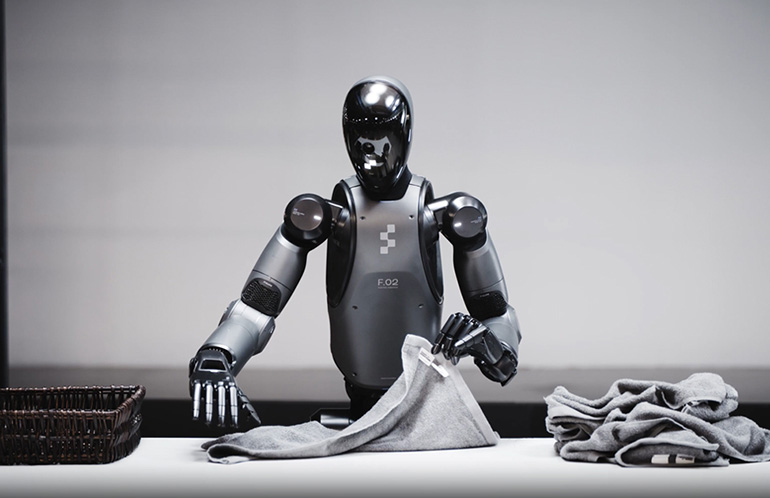

Introduction: Robots Once Had Bodies but No Minds
For most of the history of robotics, engineers focused primarily on building machines with impressive physical capabilities.
Robots could move, lift objects, and perform precise mechanical tasks. Industrial robots became incredibly efficient at repetitive work such as welding cars or assembling electronics.
But these machines had a fundamental limitation: they lacked intelligence.
Traditional robots followed strict instructions programmed by engineers. If the environment changed in unexpected ways, the robot would fail.
A robot might be able to pick up an object perfectly—but only if the object was always placed in exactly the same position.
The robot had a body, but it did not truly have a mind.
Today, that situation is beginning to change.
Advances in artificial intelligence are giving robots something they never had before: the ability to perceive, reason, and adapt.
This transformation is especially important for humanoid robots being developed by companies such as Tesla, Figure AI, and Agility Robotics.
These machines are not just mechanical systems. They are becoming intelligent agents capable of interacting with the world.
Understanding this shift requires exploring the concept of embodied AI—the idea that intelligence emerges from the interaction between a mind and a body.
From Software Intelligence to Embodied Intelligence
Why AI Alone Is Not Enough
Over the past decade, artificial intelligence has made extraordinary progress.
AI systems can now generate text, create images, write software, and analyze enormous datasets.
These capabilities are powered by large-scale neural networks developed by companies such as OpenAI and Google DeepMind.
However, most AI systems exist purely in the digital world.
They process information, but they do not physically interact with the environment.
Robots change this equation.
A robot must combine thinking and action.
It must observe the physical world, interpret what it sees, and then perform movements that affect its surroundings.
This connection between perception, reasoning, and action is what researchers call embodied intelligence.
Case Study: Teaching Robots to Understand Objects
A Simple Task That Is Surprisingly Difficult
Consider a simple task: picking up a cup from a table.
For a human, this action takes less than a second. The brain instantly recognizes the object, estimates its shape, and coordinates the hand movement required to grasp it.
For a robot, the process is far more complicated.
First, the robot must detect the object using cameras and sensors.
Next, the robot must identify the object and determine its orientation.
Then, it must calculate the exact position of its hand relative to the cup.
Finally, it must control dozens of motors to execute the movement.
Each step requires sophisticated AI algorithms.
Robots must process visual information, understand spatial relationships, and plan physical actions.
Recent advances in machine learning have dramatically improved these capabilities.
Robots can now be trained using large datasets containing millions of images and actions.
By learning from this data, robots gradually improve their ability to manipulate objects.
Case Study: Language and Robot Control
Talking to Machines
Another major development in robotics is the integration of natural language processing.
Traditionally, robots could only follow specific commands written in code.
Today, advances in language models allow robots to understand spoken instructions.
For example, a robot might receive a command such as:
“Pick up the box on the left and place it on the table.”
The robot must interpret this sentence, identify the relevant objects, and plan the sequence of movements required to complete the task.
This process involves multiple AI systems working together:
- language understanding
- visual perception
- motion planning
- physical control
Some companies are experimenting with combining large language models with robotics platforms.
This approach could eventually allow robots to learn tasks simply by receiving verbal instructions.
Case Study: Learning Through Experience
Robots That Improve Over Time
Another powerful idea in modern robotics is reinforcement learning.
Instead of programming robots with fixed instructions, engineers allow robots to learn through trial and error.
In simulated environments, robots attempt different actions and receive feedback about whether those actions were successful.
Over time, the system learns strategies that maximize success.
This approach has produced impressive results in areas such as robotic locomotion.
Some robots can now learn to walk, run, and balance by practicing in simulation environments before applying those skills in the real world.
Simulation training allows robots to gain thousands of hours of experience in a short period of time.
Once the AI system has learned effective strategies, those strategies can be transferred to physical robots.
The Role of Data
Why Robots Need Massive Datasets
Modern AI systems depend heavily on data.
For robots, data includes:
- images of objects
- recordings of human movements
- examples of successful task completion
Collecting this data can be challenging.
Unlike purely digital AI systems, robots must gather information from the physical world.
This process often requires large-scale testing in real environments.
Some companies are beginning to build massive datasets of robotic interactions.
These datasets allow AI models to learn how to perform complex tasks with increasing reliability.
The Integration Challenge
Combining Many Systems into One
Although advances in AI have been impressive, building an intelligent robot still requires integrating many different technologies.
A humanoid robot must combine:
- vision systems
- language processing
- motion planning
- mechanical control
Each of these systems must work together seamlessly.
If one component fails, the entire system may stop functioning.
Achieving reliable integration remains one of the most difficult aspects of robotics engineering.
Why Embodied AI Matters
The Future of Intelligent Machines
Embodied AI represents a new frontier in artificial intelligence.
Instead of focusing solely on digital intelligence, researchers are exploring how AI can interact with the physical world.
Humanoid robots provide an ideal platform for this research.
Because they resemble human bodies, these robots can perform many of the same tasks that humans perform.
This capability could eventually allow robots to assist in industries such as:
- logistics
- manufacturing
- healthcare
- construction
The combination of AI and robotics may lead to machines capable of performing a wide variety of tasks in human environments.
Looking Ahead
The Next Decade of Robotics
The next decade is likely to bring rapid progress in embodied AI.
Several technological trends are accelerating development:
- more powerful AI models
- improved sensors
- better simulation environments
- increased computational power
As these technologies continue to advance, robots will become more capable of understanding and interacting with the world.
Humanoid robots may gradually transition from experimental prototypes to practical tools used in everyday work environments.
Conclusion: When Robots Begin to Think
For most of the history of robotics, machines were defined by their physical capabilities.
They could move with precision but lacked true intelligence.
Today, that distinction is beginning to disappear.
Artificial intelligence is giving robots the ability to perceive, reason, and learn.
Humanoid robots are becoming platforms where mechanical engineering and machine intelligence converge.
The journey toward fully intelligent robots is still in its early stages.
But as AI systems continue to evolve, the line between thinking machines and physical machines may gradually fade.
When that happens, humanoid robots will no longer be just tools—they will become intelligent agents capable of working alongside humans in ways that were once imagined only in science fiction.
Discussion about this post