









Introduction: From Prototype to Practical Use
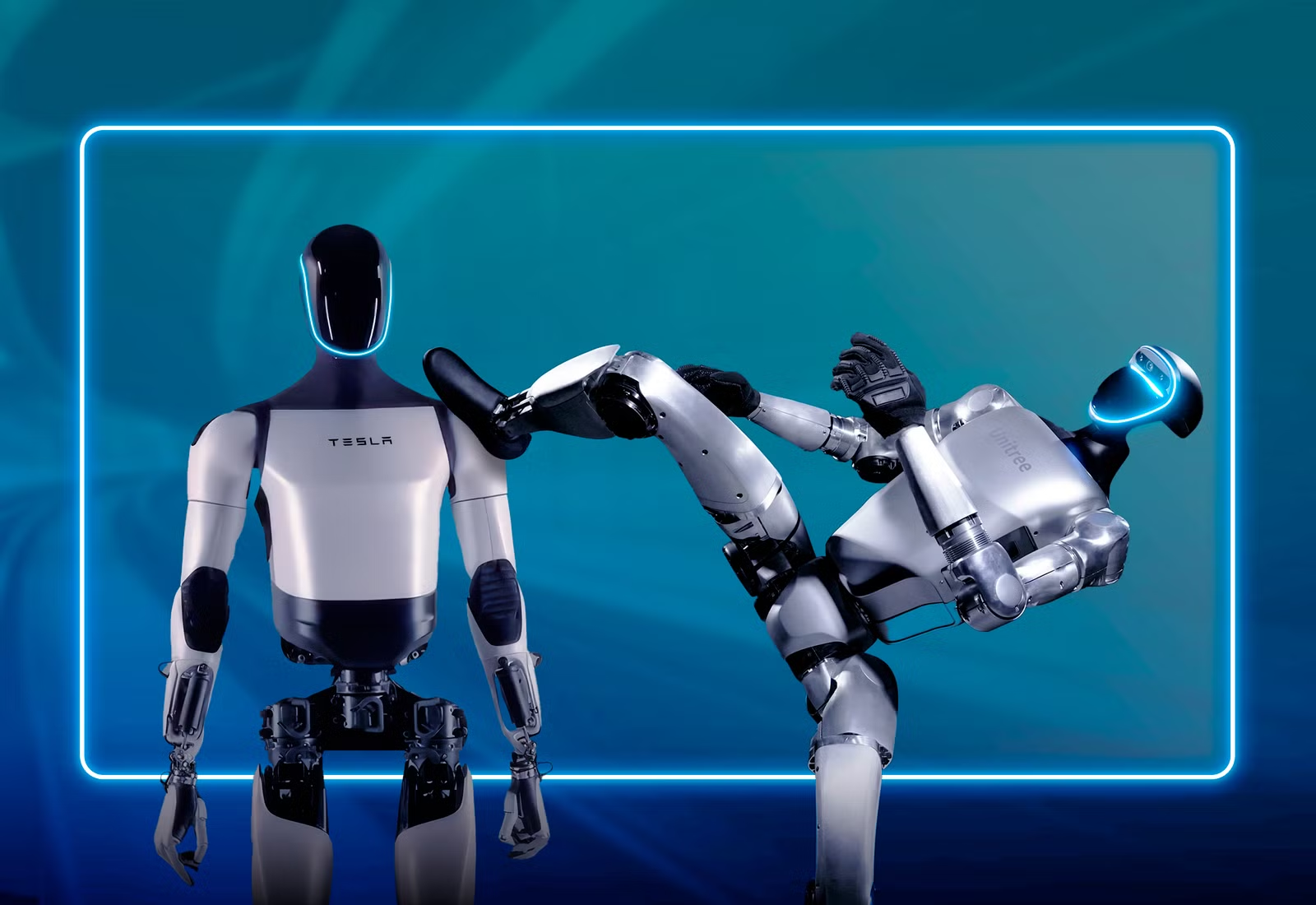
Humanoid robots have moved beyond laboratory demonstrations and are beginning to enter real-world testing environments. With multiple companies racing to launch commercially viable models, it’s essential to compare the latest machines in terms of capabilities, usability, and reliability.
This article evaluates five prominent humanoid robots currently in development or early deployment:
- Tesla Optimus – Optimus
- Boston Dynamics Atlas – Atlas
- Figure AI humanoid robot – Figure AI humanoid robot
- Agility Robotics Digit – Digit
- Humanoid model from PAL Robotics – REEM-C
The comparison focuses on mobility, manipulation, AI integration, user interaction, and industrial readiness.
Mobility: Walking, Running, and Balance
Mobility is arguably the most fundamental requirement for humanoid robots operating in human environments.
| Robot | Walking Stability | Speed | Terrain Adaptability | Highlights |
|---|---|---|---|---|
| Tesla Optimus | Moderate | 5 km/h | Indoor | Expected to integrate self-driving AI |
| Atlas | High | 8 km/h | Indoor & outdoor | Can run, jump, and recover from falls |
| Figure AI | Moderate | 4 km/h | Indoor | Focused on warehouse logistics |
| Digit | Moderate | 3 km/h | Indoor & flat outdoor | Compact and cargo-capable |
| REEM-C | Moderate | 2 km/h | Indoor | Stable, good for controlled environments |
Analysis:
- Atlas demonstrates the most impressive dynamic balance capabilities.
- Tesla Optimus is still in early testing; while promising, its mobility remains under refinement.
- Digit and Figure AI prioritize functional efficiency over speed, emphasizing load handling rather than dynamic movement.
Manipulation and Dexterity
A humanoid robot’s ability to interact with objects differentiates prototypes from practical tools.
| Robot | Manipulation Precision | Hand Design | Task Suitability |
|---|---|---|---|
| Tesla Optimus | Moderate | 5-fingered robotic hand | Light assembly, simple object handling |
| Atlas | Moderate | Gripper-based | Limited object manipulation, mobility-focused |
| Figure AI | High | Adaptive gripper | Warehouse picking, item sorting |
| Digit | Moderate | Two-fingered gripper | Package handling and transport |
| REEM-C | High | 5-fingered dexterous hand | Service tasks, research |
Key Insights:
Atlas sacrifices hand dexterity
AI Integration and Perception
Figure AI and REEM-C stand out for precision tasks.
Modern humanoid robots rely heavily on AI for perception, decision-making, and interaction with humans.
| Robot | AI Capabilities | Sensors | Autonomy Level |
|---|---|---|---|
| Tesla Optimus | Advanced LLM integration; self-driving tech | Cameras, LiDAR | Semi-autonomous, goal-directed |
| Atlas | Motion-focused AI | LiDAR, IMU | Semi-autonomous in mobility tasks |
| Figure AI | Task-specific AI | Depth cameras | Autonomous in warehouse environments |
| Digit | Navigation-focused AI | LiDAR, IMU | Semi-autonomous logistics operations |
| REEM-C | Service-oriented AI | Cameras, proximity sensors | Semi-autonomous, guided tasks |
Analysis:
- Tesla Optimus aims to leverage Tesla’s large language models and autonomous driving stack to navigate complex environments and follow natural language commands.
- Figure AI and Digit are specialized AI systems focused on efficiency in logistics and warehouse tasks rather than general-purpose reasoning.
- REEM-C emphasizes safe human-robot interaction in service environments.
User Interaction and Control
Ease of use is critical for organizations considering humanoid robots for real-world deployment.
- Tesla Optimus: Designed for goal-based commands via voice or connected interface; early versions require supervision.
- Atlas: Primarily controlled by engineers and programmers; not designed for end-user interaction.
- Figure AI: Simple dashboard for warehouse staff; automated task assignment reduces need for constant supervision.
- Digit: Can be integrated with existing warehouse software, requires minimal operator input.
- REEM-C: Intuitive touchscreens and gesture recognition enable human operators to easily guide tasks.
Key Takeaways:
- Figure AI and REEM-C excel in operator-friendly interfaces.
- Atlas remains research-focused and less user-accessible.
- Tesla Optimus promises natural interaction but is still in early testing.
Industrial Readiness and Practical Deployment
| Robot | Deployment Stage | Ideal Use Cases | Limitations |
|---|---|---|---|
| Tesla Optimus | Prototype / Early testing | Factory support, light tasks | Limited endurance, incomplete software stack |
| Atlas | Advanced prototype | Research, dynamic movement demos | High cost, limited task versatility |
| Figure AI | Beta deployment | Warehouses, logistics | Indoor only, specific task programming required |
| Digit | Early commercial | Warehouse deliveries, material transport | Limited manipulation; flat surfaces only |
| REEM-C | Commercial / research | Service, customer interaction | Slower movement; indoor-focused |
Observations:
- Figure AI and Digit have clear near-term industrial applications.
- REEM-C is optimized for human-centered environments like offices, hospitals, or labs.
- Tesla Optimus has potential for multiple applications but is still refining reliability and energy efficiency.
- Atlas remains primarily a research platform demonstrating advanced mobility.
Pros and Cons Summary
| Robot | Pros | Cons |
|---|---|---|
| Tesla Optimus | Potentially versatile, AI-rich, human-like design | Prototype stage, limited endurance |
| Atlas | Incredible dynamic movement, cutting-edge balance | Expensive, not production-ready, limited manipulation |
| Figure AI | Warehouse-ready, dexterous, autonomous | Indoor-limited, task-specific |
| Digit | Cargo-focused, integrates with logistics software | Limited dexterity, moderate speed |
| REEM-C | Service-ready, human interaction optimized | Slow, indoor-only, limited autonomy |
Conclusion: Choosing the Right Humanoid Robot
Humanoid robots are no longer just experimental curiosities—they are beginning to find specialized roles in industries ranging from logistics to service.
Key insights for decision-makers:
- Task specificity matters: Specialized robots like Figure AI and Digit outperform general-purpose prototypes in their designated environments.
- Mobility vs. manipulation trade-off: Atlas excels in mobility but lacks practical manipulation. REEM-C balances manipulation with user interaction.
- AI and interface design: Tesla Optimus shows promise with advanced AI, but its early stage means reliability and endurance remain concerns.
- Industrial readiness: Figure AI and Digit are the most deployable in near-term commercial operations. REEM-C is ready for service roles where human interaction is essential.
The right choice depends on the intended application. For warehouses, logistics-focused humanoid robots provide immediate ROI. For research, demonstration, or experimentation in human-like mobility, Atlas and Tesla Optimus offer a glimpse into future capabilities. Service environments benefit most from robots with robust human interaction design, such as REEM-C.
Final Thought:
Humanoid robots are approaching a tipping point. With continued improvements in AI, energy efficiency, and hardware, the next few years may see them move from labs and test facilities into real-world industrial and service environments, reshaping the way humans work alongside machines.
Discussion about this post