









A New Technological Arms Race
For much of the past decade, the global technology industry has been focused on artificial intelligence, cloud computing, and electric vehicles. Now, a new frontier is emerging at the intersection of these technologies: humanoid robotics.
Around the world, governments, startups, and major technology corporations are investing billions of dollars into building robots that can walk, manipulate objects, and collaborate with humans. The ambition is not simply to build impressive machines, but to create a new class of intelligent workers capable of transforming industries.
Many analysts now describe humanoid robotics as the next great technological race—comparable to the space race of the 20th century or the global competition for artificial intelligence leadership today.
Countries that succeed in developing scalable humanoid robot industries could gain enormous economic advantages.
Factories could operate with fewer labor constraints, logistics networks could become dramatically more efficient, and entire sectors—from construction to elder care—could be reshaped.
At the center of this race are several technology companies and research institutions pushing the boundaries of robotics engineering.
The United States: Startups and Silicon Valley Innovation
The United States remains one of the most influential hubs for humanoid robotics development, driven largely by venture capital and the entrepreneurial ecosystem of Silicon Valley.
One of the most closely watched companies is Figure AI, a robotics startup founded in 2022. The company quickly attracted major investment from technology leaders and venture capital firms, raising hundreds of millions of dollars to accelerate the development of humanoid robots designed for commercial deployment.
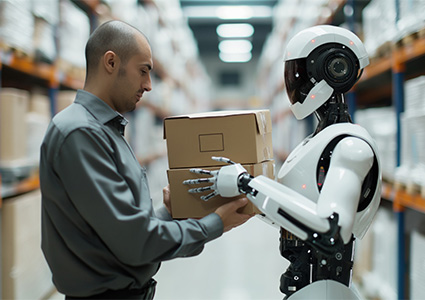
Its flagship robot, Figure 01, has demonstrated the ability to walk autonomously, manipulate objects with humanlike hands, and perform simple warehouse tasks.
What makes the company particularly notable is its collaboration with OpenAI, which provides advanced AI models that allow robots to understand language and interact with humans more naturally.
Instead of following rigid instructions, these robots can interpret verbal commands and adapt their actions accordingly.
Another major player is Tesla, which has entered the robotics field with ambitious goals.
Its humanoid robot, Tesla Optimus, is intended to assist with repetitive and physically demanding tasks in factories. According to Elon Musk, the long-term vision is to create millions of these robots that could eventually work across a wide range of industries.
While the technology is still evolving, Tesla’s manufacturing expertise and experience with large-scale production could give it a significant advantage if humanoid robots move toward mass deployment.
Europe: Engineering Precision and Industrial Applications
Europe’s robotics industry has traditionally focused on precision engineering and industrial automation. This legacy continues to influence the region’s approach to humanoid robots.
One of the most famous robotics companies in the world, Boston Dynamics, has deep research roots and continues to push the boundaries of robotic mobility.
Its humanoid platform, Atlas, is widely regarded as one of the most advanced robots ever built. The machine can run, jump, and perform complex maneuvers that were once thought impossible for robots.
Recent demonstrations show Atlas performing industrial tasks such as lifting and placing heavy components, suggesting the company is gradually shifting toward commercial applications.
Meanwhile, European research institutions are exploring collaborative robots—machines designed to work alongside humans safely.
This focus reflects Europe’s strong labor regulations and emphasis on worker protection.
Rather than replacing human workers outright, many European robotics programs aim to create systems that augment human capabilities.
China: Scaling Robotics Manufacturing
China has rapidly emerged as a major force in the robotics industry.
Driven by national industrial policies and strong manufacturing capabilities, Chinese companies are investing heavily in humanoid robotics development.
One prominent example is UBTECH Robotics, which has developed several humanoid robots designed for education, service industries, and industrial use.
China’s robotics strategy aligns closely with broader government initiatives to modernize manufacturing and reduce dependence on human labor.
As the country’s population ages and wages rise, automation is becoming an increasingly attractive solution.
China’s manufacturing scale could prove decisive.
If humanoid robots reach mass production, Chinese factories may be capable of producing them faster and more cheaply than competitors.
This potential advantage has intensified the global competition for robotics leadership.
The Technology Behind Humanoid Robots
Developing a humanoid robot is an extraordinarily complex engineering challenge.
Each machine must combine multiple advanced technologies, including mechanical engineering, artificial intelligence, sensor systems, and battery management.
One of the most difficult challenges is mobility.
Walking on two legs requires precise balance control and rapid adjustments to maintain stability. Humans perform these calculations subconsciously, but for robots, they require sophisticated algorithms and high-speed sensors.
Another major challenge is manipulation.
Human hands contain more than 20 degrees of freedom, allowing us to grasp delicate objects and perform complex tasks. Replicating this dexterity in robotic systems remains one of the hardest problems in robotics.
Recent advances in AI have begun to address these challenges.
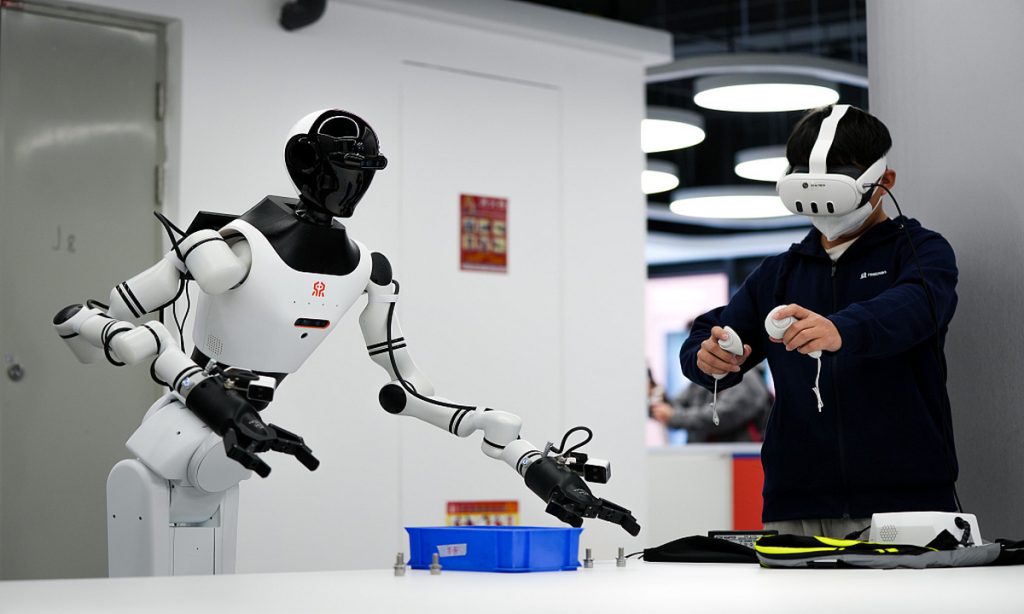
Machine learning algorithms can now train robots through simulation, allowing them to practice thousands of movements in virtual environments before applying those skills in the real world.
This dramatically accelerates development.
The Role of Artificial Intelligence
Artificial intelligence has become the central driver of modern robotics progress.
Traditional robots relied on preprogrammed instructions and could perform only narrow tasks.
Today’s robots are increasingly capable of perception, reasoning, and adaptation.
Large multimodal models can process images, language, and sensor data simultaneously, enabling robots to understand their surroundings in ways that were previously impossible.
For example, a robot equipped with AI vision systems can recognize tools, identify obstacles, and determine the best way to complete a task.
This capability allows robots to function in complex environments such as warehouses or construction sites.
Some researchers believe that integrating large language models with robotics could create a new generation of machines capable of learning directly from human instructions.
Instead of programming robots line by line, humans could simply describe what needs to be done.
Capital Flows into Robotics
The rapid growth of humanoid robotics has attracted enormous investment from venture capital firms and technology giants.
In recent years, robotics startups have collectively raised billions of dollars in funding.
Investors see humanoid robots as a potentially massive market.
If robots eventually become as common as smartphones or automobiles, the industry could be worth trillions of dollars.
Major technology companies are also investing heavily in robotics research, recognizing that physical automation could represent the next stage of artificial intelligence.
These investments are accelerating innovation across the entire sector.
Policy and Regulation
Governments are also beginning to take a more active role in shaping the future of robotics.
Several countries have introduced national robotics strategies aimed at strengthening research, supporting startups, and encouraging industrial adoption.
These policies often focus on workforce training, infrastructure development, and safety standards.
Regulation will play a crucial role in determining how quickly humanoid robots can enter the workforce.
Authorities must establish guidelines for safety certification, liability, and data privacy.
Balancing innovation with public safety will be one of the central challenges for policymakers.
Challenges That Remain
Despite rapid progress, humanoid robots still face significant obstacles before they become widespread.
Cost remains one of the largest barriers.
Most humanoid robots today are extremely expensive, limiting their adoption to research labs and pilot programs.
Reliability is another issue.
Robots must operate continuously in demanding environments without frequent maintenance.
Energy efficiency also poses challenges.
Humanoid robots consume significant power, and current battery technologies limit operating time.
Solving these problems will require continued breakthroughs in engineering and materials science.
The Next Decade of Robotics
Many experts believe the 2020s will mark the beginning of large-scale humanoid robot deployment.
Factories and warehouses will likely be the first environments where these machines become common.
From there, robots may gradually expand into other sectors such as construction, healthcare, and retail.
The implications could be enormous.
If humanoid robots become affordable and reliable, they could reshape the global economy.
Productivity could increase dramatically, but societies will also need to address the social consequences of widespread automation.
The global humanoid robot race is still in its early stages.
But the competition is intensifying—and the stakes are higher than ever.
Discussion about this post