









Forget the Hype—This One Is Already Working
For years, humanoid robots have been judged by what they could do.
Jump higher.
Move faster.
Look more human.
But none of those things answer the only question that matters in business:
Can it generate value today?
That’s where Digit stands apart.
Built by Agility Robotics, Digit is not the most advanced humanoid robot.
It is not the smartest.
It is not the most agile.
It is not the most futuristic.
But it might be the first one that actually works at scale in the real economy.
And that changes everything.
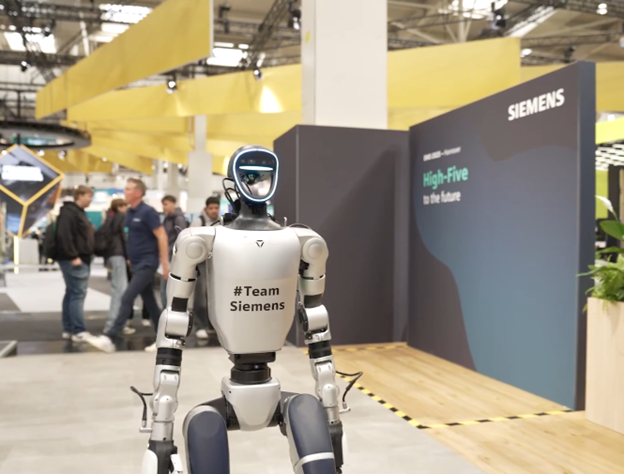
Design Philosophy: Not Fully Human—and That’s the Point
Digit doesn’t try to look like a human.
Its legs are bird-like.
Its arms are simplified.
Its head is minimal, almost symbolic.
At first glance, it feels less “humanoid” than competitors like Tesla Optimus or Figure 01.
But this is not a compromise.
It is optimization.
Agility Robotics has made a deliberate decision:
👉 Keep what is useful from human form.
👉 Remove what is not.
For example:
- Two legs → essential for human environments (stairs, narrow paths)
- Arms → necessary for carrying objects
- Human-like proportions → useful for existing infrastructure
But:
- No complex hands
- No expressive face
- No unnecessary degrees of freedom
The result is a robot that is simpler, cheaper, and more reliable.
And in business, those three things matter more than perfection.
The Real Use Case: Logistics, Not Sci-Fi
Digit is not trying to do everything.
It is built for one primary domain:
Logistics.
Specifically:
- Warehouse item movement
- Tote handling
- Last-meter delivery inside facilities
This focus is critical.
Most robotics companies fail because they try to solve too many problems at once.
Digit does the opposite.
It solves one problem very well:
👉 Moving objects from point A to point B in human-designed spaces.
And that problem is massive.
Global logistics is a multi-trillion-dollar industry, with persistent labor shortages and high turnover rates.
Digit doesn’t need to be perfect.
It just needs to be cheaper or more reliable than human labor for repetitive tasks.
Real Deployment: This Is Not a Demo
Here’s where Digit separates itself from almost every other humanoid robot:
It is already being tested in real operations.
Most notably, through partnerships with Amazon.
Unlike controlled demos, these deployments involve:
- Real warehouses
- Real workflows
- Real constraints
This introduces challenges that lab environments hide:
- Irregular object flow
- Human interaction
- System integration
- Downtime and maintenance
And yet, Digit is operating within this complexity.
That alone puts it ahead of many competitors.
Mobility: Designed for the Real World, Not the Lab
Digit’s movement is less dramatic than Atlas, but more practical.
It can:
- Walk efficiently on flat surfaces
- Navigate warehouse layouts
- Maintain balance while carrying loads
It does not jump.
It does not run.
But it doesn’t need to.
In logistics environments, predictability beats performance.
A robot that moves consistently is more valuable than one that occasionally does something extraordinary.
Manipulation: Good Enough Is Good Enough
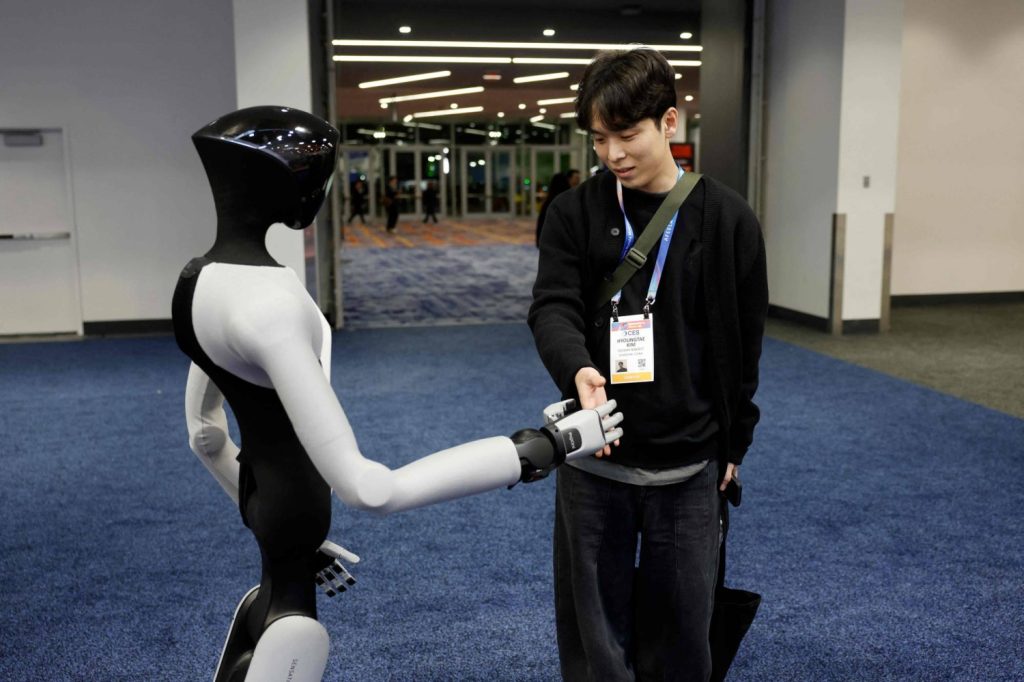
Digit’s manipulation capabilities are intentionally limited.
It is designed to:
- Pick up standardized containers
- Carry loads
- Place items accurately
It is not designed for:
- Fine assembly
- Complex tool use
- Irregular object handling
This may seem like a weakness.
But it is actually a strength.
By limiting scope, Digit achieves:
- Higher reliability
- Faster deployment
- Lower cost
In business, “good enough” often wins over “perfect.”
System Integration: The Hidden Advantage
One of the hardest parts of deploying robots is not the robot itself.
It is integration.
Digit is designed to work within existing systems, including:
- Warehouse management software
- Conveyor systems
- Human workflows
This is crucial.
A robot that requires a complete infrastructure overhaul is difficult to adopt.
Digit fits into what already exists.
And that dramatically lowers the barrier to entry.
Economics: The Only Metric That Matters
Let’s talk about money.
For Digit to succeed, it must compete with human labor.
That means:
Costs
- Hardware production
- Maintenance
- Energy consumption
- Software updates
Benefits
- 24/7 operation
- Reduced labor dependency
- Consistent performance
- Lower error rates
The key metric is simple:
👉 Cost per task vs human cost per task
Digit does not need to be cheaper immediately.
It just needs a clear path to becoming cheaper at scale.
And unlike more complex humanoid robots, it actually has that path.
Manufacturing: Built for Scale
Agility Robotics is investing in manufacturing capacity—most notably with its dedicated robot factory.
This signals a shift from:
👉 Prototype → Product
Scaling production is one of the biggest challenges in robotics.
Many companies build impressive robots but cannot produce them efficiently.
Digit is being designed with manufacturability in mind from the start.
That gives it a significant advantage.
Digit vs The Competition: A Different Game
Comparing Digit to other humanoid robots highlights a key insight:
They are not solving the same problem.
| Robot | Goal | Strategy |
|---|---|---|
| Optimus | Mass deployment | Scale manufacturing |
| Figure 01 | General intelligence | AI-first approach |
| Atlas | Engineering frontier | Mobility excellence |
| Digit | Revenue generation | Narrow use case |
Digit is not trying to win the “best robot” competition.
It is trying to win the “first profitable robot” race.
Limitations: The Trade-Offs
Digit’s focused approach comes with constraints.
1. Limited Flexibility
It cannot easily adapt to new tasks.
2. Narrow Use Case
Primarily suited for logistics.
3. Lower Ceiling
It may never achieve general-purpose capabilities.
4. Competition from Non-Humanoid Robots
Wheeled robots can be cheaper in some scenarios.
These are real limitations.
But they are also what make Digit viable today.
The Bigger Picture: Why Digit Matters
Digit represents a shift in robotics:
👉 From possibility → profitability
For decades, robotics has been driven by technological ambition.
Now, it is being driven by economic reality.
The first company to prove that humanoid robots can generate consistent returns will unlock massive investment.
Digit is currently one of the strongest candidates to do that.
Final Verdict
Digit is not the future of humanoid robots.
It is the beginning of their business model.
It proves that:
- You don’t need perfect intelligence
- You don’t need extreme agility
- You don’t need human-level capability
You just need to solve a real problem—better than humans can.
Score
- Practicality: 9/10
- Engineering: 7.5/10
- AI Capability: 7/10
- Commercial Readiness: 9.5/10
- Long-term Potential: 8/10
Overall: 8.6/10
Discussion about this post