









Introduction: Sliding the Metal Curtain
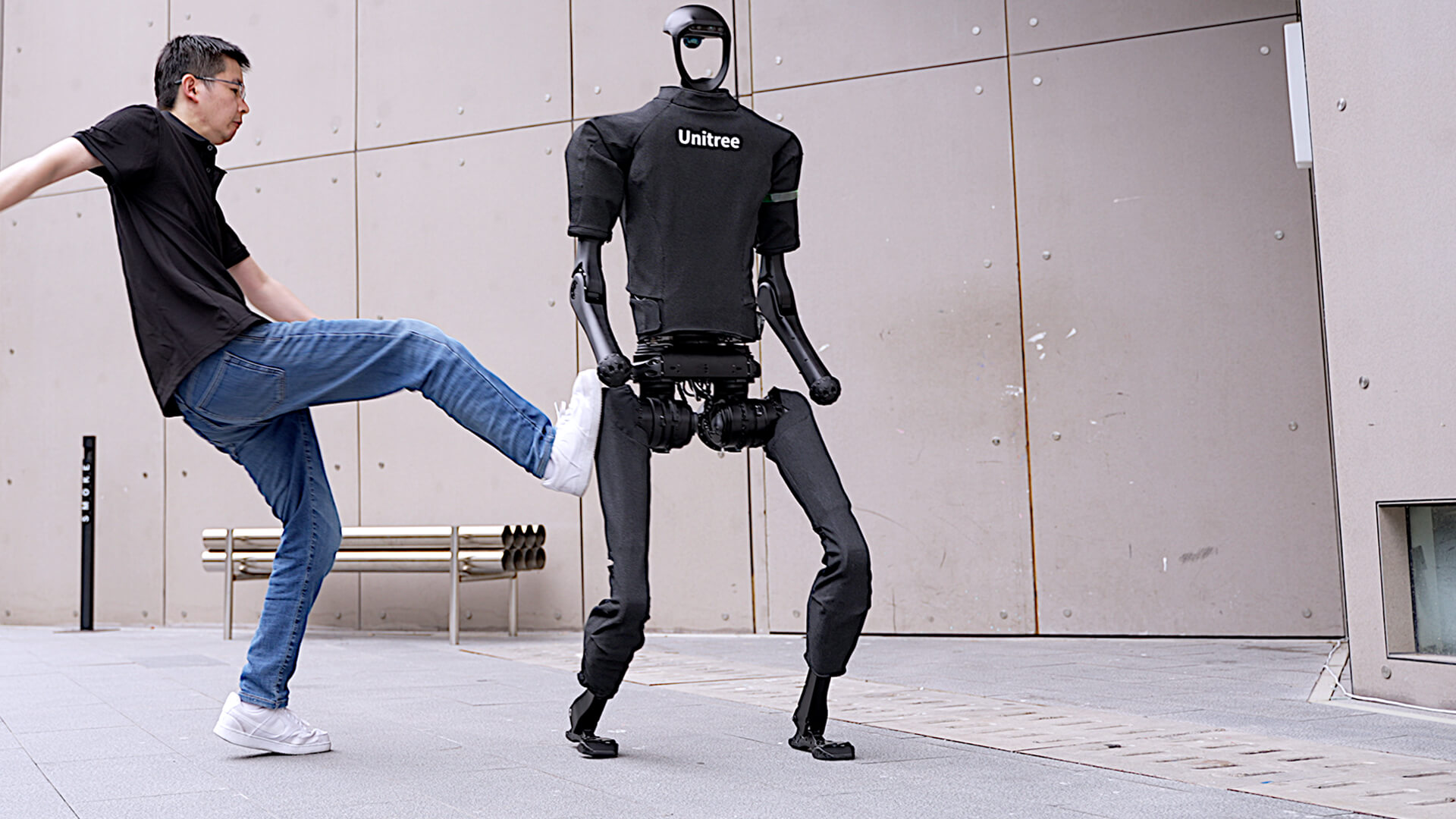
When we talk about robots that move like humans, most of us conjure up images of sci‑fi androids gliding across a room—effortlessly balancing, walking, running, maybe even dancing. That mental picture keeps getting fuzzier and more exciting every time a new video drops. And nestled within all of this is the Unitree H1—Unitree Robotics’ first full‑size general‑purpose humanoid robot, engineered not just to stand and wave, but to walk, run, and navigate the real world with balanced, controlled locomotion.
But how human‑like is its movement in reality? Let’s peel this question layer by layer, starting at the nuts and bolts before diving into the philosophy of motion itself.
Unitree H1’s Physical Blueprint: The Skeleton of Motion
To understand movement, you must first understand the underlying structure. The Unitree H1 adopts a classic humanoid form factor:
- Height: ~180 cm
- Weight: ~47 kg
- Leg joints: 5 degrees of freedom per leg (hip × 3, knee × 1, ankle × 1)
- Arm joints: 4 degrees of freedom per arm (expandable)
- Sensors: 3D LiDAR + depth camera for 360° spatial awareness
- Control System: Intel Core i5/i7 with optional high‑performance Nvidia Jetson Orin processors
In contrast to quadrupeds that balance with four points of contact, bipedal robots like H1 rely on precise control of center of mass and angular momentum to stay upright. Humans use intricate feedback loops and thousands of muscles; robots like H1 approximate this with actuators, high‑torque motors, and advanced sensors.
Degrees of Freedom: A Signature of Movement Fidelity
Degrees of Freedom (DOF) in robotics represents how many separate ways a joint can move. A human hip alone has three rotational degrees—forward/backward, sideways, and rotation. The knee bends in one primary direction, and the ankle pivots to help balance. The cumulative pattern enables complex motion.
In H1:
- 5 DOF per leg means it can flex and extend, rotate, and make subtle ankle adjustments, but not with the full nuance of a human ankle that has multiple micro‑motions.
- 4 DOF per arm limits fine manipulation yet supports basic positioning and coordinated motion.
This configuration gives H1 a human‑like skeleton on paper, yet true human motion depends on micro adjustments, reflexes, and continuous feedback loops that are still beyond the reach of most current robotics systems.
Momentum, Balance, and Gait: How H1 Walks and Runs
One of the most impressive aspects of the H1 is its mobility performance. Unitree claims a top horizontal speed of 3.3 m/s with potential performance over 5 m/s. That’s faster than the motion you’d expect if this were merely a toy or static robot.
This tells us a few things:
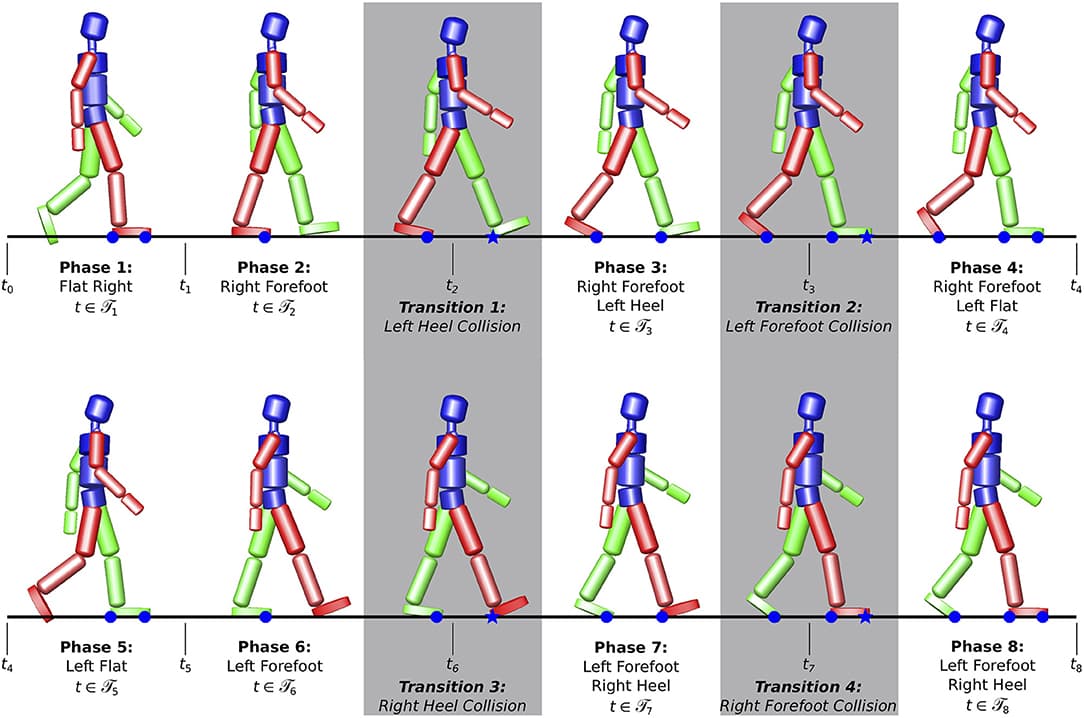
1. Dynamic Gait, Not Static Marching
Static robots move in stiff, jerky steps—like a novice learning to walk on stilts. H1 instead uses a dynamic gait: a blend of controlled balance, timed joint motion, and intelligent sensor feedback to shift its weight with intention. This is a crucial component of human‑like walking.
2. Stability Through Sensor Fusion
With 3D LiDAR and depth cameras, H1 constantly surveys its surroundings. This enables it to adjust strides and maintain balance—even over varied terrains. A human instinctively shifts balance if the ground dips; H1 must compute it.
3. Joint Torque: Strength and Control
H1’s joint motors deliver significant torque (e.g., ~360 N·m at the knee), which provides strong force transmission for rapid movement and stable posture corrections. Without sufficient torque, the robot would simply topple.
Sensory Feedback: The Robot’s Window to the World
Humans balance through proprioception—signals from muscles and joints to the brain. H1 substitutes this with LiDAR and depth sensing, giving it real‑time spatial data. Rather than feeling the ground, it perceives it, using algorithms to modulate balance and gait.
This sensory fusion allows:
- Obstacle avoidance
- Terrain mapping
- Adjustments in stride timing
- Autonomous navigation
These are foundational to biologically plausible movement, even if the underlying mechanisms are algorithmic rather than muscular.
Where H1 Shines—and Where It Trails Humans
Human‑Like Strengths
✔ Balanced, autonomous stepping
✔ Impressive acceleration and running speed
✔ Perception‑driven adaptation to terrain changes
✔ Torque‑rich joints similar to muscle output

These make H1’s movement much closer to human locomotion than early generation robots. A robot that can run, turn, and recover with autonomous balance is no small feat.
Remaining Gaps
✖ Reflexive micro‑adjustments — humans adjust instantly; robots follow programmed responses.
✖ Fine limb articulation — 4 DOF arms are functional yet not dexterous.
✖ Soft tissue flexibility — no tendons, elastic compensation, or subtle stabilization features seen in mammals.
In many ways, H1 is movement‑capable, not human‑equivalent. It doesn’t “feel” movement the way humans do—yet it executes it impressively well for a machine.
Comparisons: What Real Human‑Like Movement Would Look Like
Consider a ballet dancer versus a running marathoner: both require different balance strategies, coordination, and muscle engagement. A robot must solve all of these mathematically.
H1’s motion is:
- Planned and sensor‑driven
- Highly optimized for forward gait and balance
- Less nuanced for unpredictable micro‑adjustments
- Lacking intuitive decision‑making for new movement patterns without training or programming
In contrast, human movement is:
- Adaptive on the fly
- Powered by nervous systems and reflex arcs
- Flexible in unexpected scenarios
This comparison highlights that similar outcomes can come from very different internal processes—robotic control versus biological instinct.
Conclusion: How Human‑Like Is It, Really?
Unitree H1’s movement is a remarkable technological achievement that echoes human locomotion in many functional respects:
- It walks autonomously, adjusting to terrain.
- It runs with dynamic stability and significant torque support.
- It balances using sensor fusion and fast control loops.
- It embodies a human‑like silhouette with purposeful joint sequencing.
But “human‑like” isn’t a binary label. It’s a spectrum. On that spectrum:
- H1 is far closer to human locomotion than most robots ever built.
- Yet it remains distinctly mechanical, bounded by actuator limits, discrete computation, and engineered control.
In short: H1 moves like a robot that has learned to mimic humans—not like a robot that feels human movement intrinsically.
For engineers, researchers, and robot enthusiasts around the world, that’s already thrilling enough.