








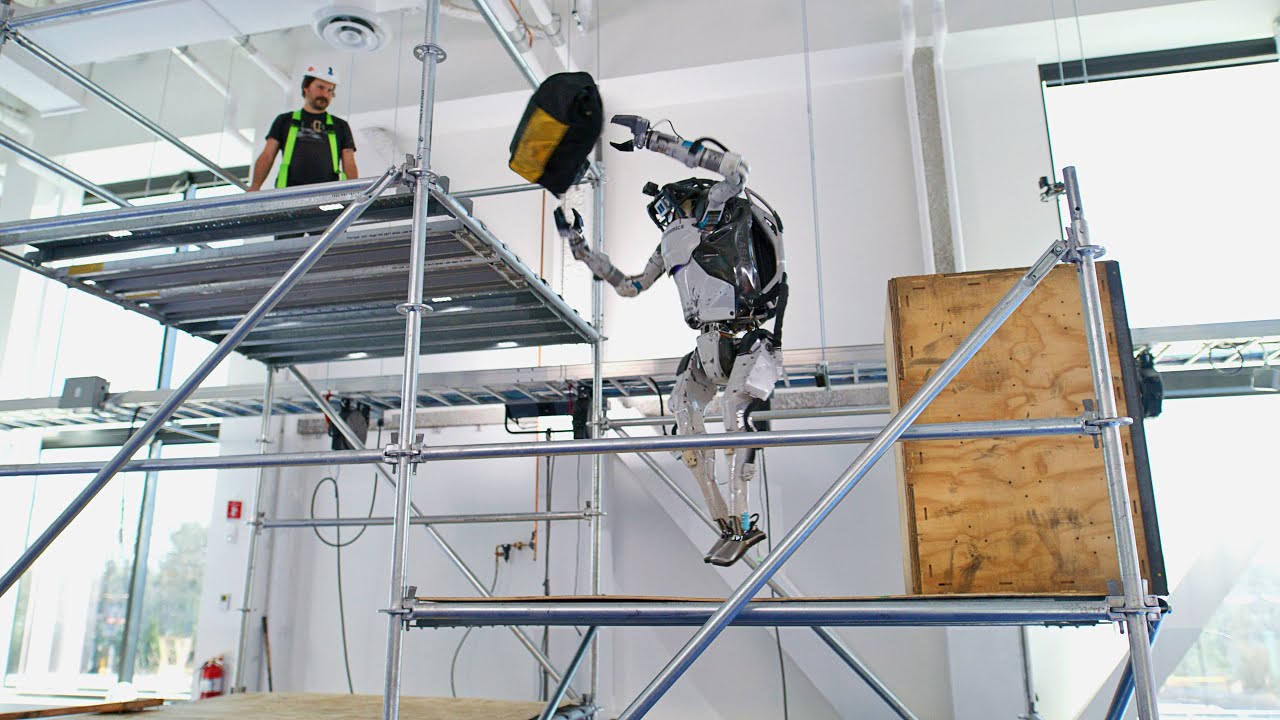

From viral parkour clips to headlines about robots joining factory floors, Boston Dynamics’ Atlas has captured the imagination of technologists, futurists, and everyday people alike. But used casually, hype can obscure reality. What truly distinguishes Atlas from other robots—not only in form but in function, engineering, design philosophy, and real world potential—deserves a close, thoughtful examination.
In this deep dive, we’ll explore Atlas through multiple lenses: mechanical engineering, perception and intelligence, real‑world utility, industry context, comparison with other robots, and the future trajectory of humanoid robotics.
1. The Roots: Where Atlas Came From
Boston Dynamics did not invent humanoid robots, but it helped define them in the modern era.
Atlas began life under a contract with DARPA—the U.S. Defense Advanced Research Projects Agency—and was initially intended for search and rescue tasks where human lifesaving teams couldn’t safely go. Early Atlas versions were hydraulic, tethered, and research‑oriented. Over the years, it became one of the most advanced bipedal robots ever built.
In April 2024, Boston Dynamics retired its older hydraulic Atlas and introduced a fully electric model, marking a clear pivot from prototype demos to a robot that could be industrial, practical, and scalable.
So what does that mean in real terms? Let’s break that down.
2. Anatomy of a Robot: Design and Hardware
At its core, Atlas’s mechanical design is engineered for mobility, strength, adaptability, and interaction with human environments.
2.1. Full‑Body Dexterity
Unlike wheeled, tracked, or fixed‑arm robots that are limited by terrain or task type, Atlas has **56 degrees of freedom ** — more than most contemporary robots. This means nearly every joint (hips, ankles, spine, arms, head) can move independently, letting the robot twist, rotate, step, turn, or even pivot without completing a full turn.
This gives Atlas remarkable agility: it can walk, balance dynamically, lift, reach, and manipulate objects in three dimensions across unstructured environments.
2.2. Mobility Beyond Wheels
Atlas walks on two legs—a profound difference from nearly all current industrial automata. Quadrupeds like Spot or wheeled robots excel on predictable surfaces, but bipedal locomotion is uniquely useful for navigating stairs, obstacles, and human‑scaled spaces.
In robotics, balance—particularly in dynamic motion—is hard. Atlas not only maintains balance but performs whole‑body acts such as leg swings, lateral shifts, and core stabilization through sophisticated control loops and sensor fusion.
2.3. Strength and Environmental Resilience
Atlas is designed to be work‑ready:
- Can lift up to 50 kg (110 lbs) — a serious payload for a standard humanoid.
- Operational in diverse climates (from -20°C to 40°C).
- Water‑resistant and ruggedized for real manufacturing needs.
All told, its hardware spec looks more like industrial machinery than a laboratory toy.
3. The Brains: AI, Sensors, and Perception
What good is a robot that can move if it can’t understand where it is or what it’s interacting with?
Atlas integrates multi‑modal perception that fuses vision, inertial data, force feedback, and depth sensing.
3.1. Sensor Fusion
Atlas processes:
- RGB cameras
- Depth and lidar systems
- Inertial measurement units
- Force and tactile sensors
This allows it to build a real‑time picture of its surroundings, recognize obstacles, and adapt its movements dynamically—crucial for unstructured environments where no two moments look the same.

3.2. AI and Learning
Atlas isn’t controlled purely by scripted motion.
Boston Dynamics and partners like the Robotics & AI Institute use reinforcement learning and large behavior models to train Atlas for generalized motor skills—which is a way to make robots react and adapt without pre‑programming every angle.
This is profound because many robots today depend on static instructions. Atlas’s algorithms can teach it movement strategies that generalize across tasks, a step closer to true robotic adaptability.
4. Atlas Versus Other Robots: A Comparative Landscape
To understand what sets Atlas apart, we need some context.
There are many robotic platforms, but they typically fall into a few categories:
4.1. Wheeled Wheeled Robots
Examples: warehouse carts, automated guided vehicles.
- Pros: Highly efficient on flat surfaces, simple design.
- Cons: Cannot navigate stairs or unstructured terrain.
Atlas beats them easily in environmental versatility because it walks and balances like a human.
4.2. Quadrupeds (e.g., Spot)
Four‑legged designs are more stable than bipeds and can traverse rough terrain well.
- Pros: Stability, payload, autonomous navigation.
- Cons: Still not optimal for human‑oriented environments like stairs or tight spaces.
Atlas’s bipedal mobility gives it unique spatial adaptability.
4.3. Static Industrial Arms
These robots are everywhere on assembly lines.
- Pros: Speed, precision, repeatability.
- Cons: Limited workspace, need fences and cables.
Atlas’s ability to operate untethered among humans is a leap in flexibility.
4.4. Other Humanoids (e.g., Tesla Optimus, Figure AI robots)
The humanoid robot race is heating up. Companies like Figure AI and Tesla are building similar platforms.
Here’s where Atlas’s approach diverges:
- Hyundai/Boston Dynamics focuses on ruggedized industrial utility alongside research benchmarking.
- Tesla emphasizes consumer affordability and large‑scale general deployment.
- Figure AI focuses on warehouse/logistics tasks with its own hardware stack.
Atlas’s design is not cheap because it’s engineered from the ground up to handle real factory conditions and unstructured physical interaction—not just controlled demos.
5. Real‑World Applications: More Than Parkour
Early Boston Dynamics footage famously featured Atlas doing backflips and parkour. They were fun—and amazing—but they were research demonstrations, not use cases.
Today, Atlas is pivoting toward real industrial tasks:
- Automotive assembly sequencing (Hyundai).
- Repetitive or dangerous work, reducing risk to human workers.
- Integration with warehouse software ecosystems (MES, WMS).
Importantly, Atlas can operate semi‑autonomously, teleoperate when needed, or function with a supervisory control layer depending on task complexity.
This is a leap from robots that only demonstrate capability to robots that execute real tasks reliably.

6. Safety, Human Interaction, and Trust
Many robots today operate behind fences because of safety concerns. Atlas includes human detection and fenceless guarding systems, meaning it can slow or stop when humans are nearby instead of plowing through a workspace.
This is less flashy than flips but far more critical for real‑world adoption.
7. Economics and Scalability
Yes, Atlas’s price tag is high today—far above consumer platforms. But Hyundai’s plan to produce tens of thousands of units annually by 2028 shows an ambition to bring scale and reduce per‑unit costs over time.
This signals a shift from robotics as R&D showcases to robotics as deployable automation.
8. Challenges and Limitations
No technology is perfect.
8.1. Dexterity Limits
Dexterous hands are harder than balanced walking. Atlas’s current hands are effective but not yet capable of human‑level fine manipulation—one of the biggest bottlenecks in general robotics.
8.2. Power and Endurance
Battery life remains limited compared to industrial arms that run off mains power. Autonomous battery swapping helps, but energy density is a constraint.
8.3. Cost and Accessibility
Atlas is not yet a consumer product—unlike some competitors targeting affordability.
9. What Really Sets Atlas Apart
After all this, what makes Atlas different?
9.1. Humanoid Mobility in Real Environments
Atlas moves like a person, not like a machine with wheels, tracks, or fixed arms.
9.2. Integrated AI and Perception
The combination of real‑time perception, sensor fusion, and adaptive learning makes Atlas less scripted and more responsive.
9.3. Industrial‑Ready Design Philosophy
Atlas is built for actual work, not just labs or trade show demos.
9.4. Safety and Collaboration
Human‑aware operations set Atlas up for collaboration rather than isolation.
10. The Future: Toward Human‑Robot Symbiosis
Atlas sits at a unique junction: blending mechanical ingenuity and AI, bridging research and real industrial use. The next decade likely won’t see robots replace humans wholesale, but robots like Atlas could augment human capabilities—taking dangerous, repetitive, or ergonomically damaging tasks off the human plate and enabling workers to focus on higher‑value, creative work.
In doing so, Atlas and its successors could help shape a robotics ecosystem where humans and robots don’t compete but complement each other.