









1. The First Shift
At 6:42 a.m., before the first human worker clocks in, the warehouse is already awake.
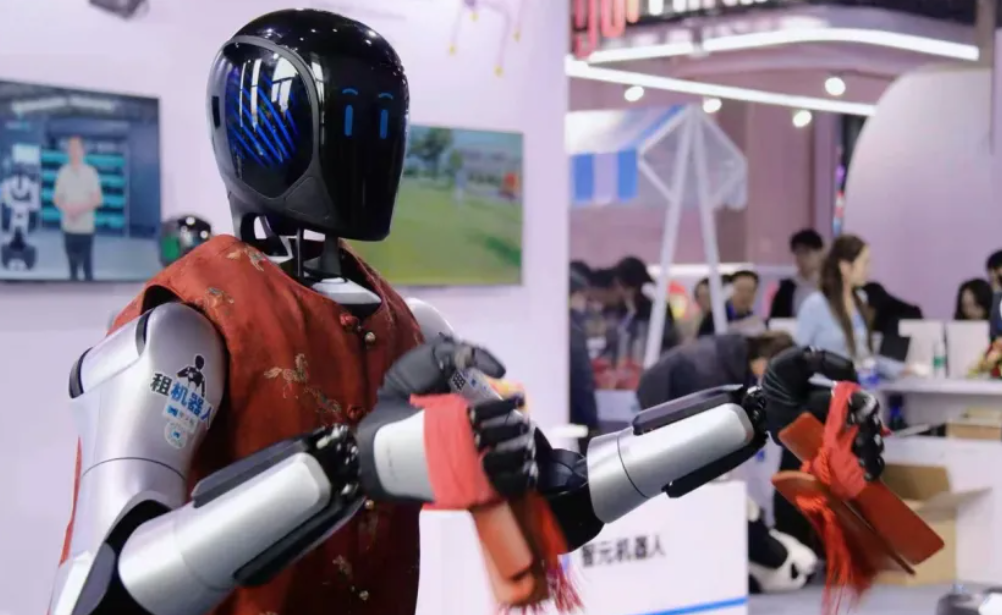
Fluorescent lights hum softly above long aisles of plastic bins. Conveyor belts begin their steady motion. And near Dock C, a humanoid robot stands motionless for a moment—before taking its first step of the day.
It walks forward, pauses, adjusts its balance, and lifts a gray container from a stack.
There is no hesitation. No stretching. No coffee break.
“It doesn’t get tired,” says Daniel Wu, a floor supervisor who has worked in logistics for more than a decade. “That’s the whole point.”
The machine is Digit, developed by Agility Robotics, and this warehouse—operated in partnership with Amazon—is one of the first real-world environments where humanoid robots are being integrated into daily operations.
For years, robots in warehouses have been limited to wheels and arms—fast, efficient, but confined to structured tasks.
Humanoid robots are different.
They move through the same spaces as humans.
They carry objects the same way.
They occupy the same roles.
And that is precisely why their presence feels different.
2. The Worker
Maria Gonzalez has worked in warehouses for eight years.
Her job used to involve lifting and moving containers—sometimes hundreds in a single shift.
“It’s repetitive,” she says. “But it’s steady work.”
When the robots arrived, she wasn’t told much.
“Just that they were here to help,” she recalls.
At first, the machines were slow. They moved cautiously, stopping frequently as engineers monitored their behavior.
Now, months later, they are faster—and more confident.
Maria’s role has changed.
Instead of carrying containers, she now monitors flows, resolves exceptions, and occasionally steps in when the robot encounters something unexpected.
“It’s less physical,” she says. “But also… I don’t know. It feels different.”
Different how?
She pauses.
“Like the job isn’t really mine anymore.”
3. The Engineer
Upstairs, in a glass-walled control room overlooking the warehouse floor, engineers watch everything.
Multiple screens display real-time feeds:
- Robot positions
- Task queues
- Error alerts
“This is where the real work happens,” says Kevin Patel, a robotics engineer involved in the deployment.
He points to a screen showing a robot hesitating near a conveyor.
“See that? It’s not sure about the object orientation.”
Within seconds, the system adjusts.
“That’s the challenge,” Patel explains. “The real world is messy. Humans deal with that intuitively. Robots don’t.”
Despite advances in AI, humanoid robots still struggle with edge cases:
- Misaligned objects
- Unexpected obstacles
- Variations in lighting
Each of these scenarios requires data, training, and iteration.
“We’re not replacing humans,” Patel says. “We’re learning from them.”
But even he admits the trajectory is clear.
“They get better every month.”
4. The Manager
For warehouse managers, the appeal of humanoid robots is straightforward.
Consistency.
“Humans are amazing,” says Rachel Kim, operations director. “But they’re also unpredictable.”
People get tired.
They make mistakes.
They call in sick.
Robots do none of these things.
From a business perspective, the calculation is simple:
- Can the robot perform the task reliably?
- Can it do so at a lower long-term cost?
If the answer is yes, adoption becomes inevitable.
But Kim is cautious.
“This isn’t about replacing everyone,” she says. “It’s about redefining roles.”
Still, she acknowledges the tension.
“Change like this is never neutral.”
5. The Silent Transformation
Unlike past waves of automation, the introduction of humanoid robots does not feel dramatic.
There are no massive layoffs.
No sudden shutdowns.
Instead, the change is gradual.
Tasks shift.
Roles evolve.
Responsibilities blur.
Humans move from doing the work to overseeing it.
At first glance, this seems like progress.
Less physical strain.
More technical roles.
But beneath the surface, something more complex is happening.
Work is becoming less about action—and more about supervision.
And not everyone finds that transition comfortable.
6. The Psychological Shift
Several workers describe a subtle but persistent feeling:
Being watched.
Not by managers—but by machines.
Humanoid robots are equipped with sensors:
- Cameras
- Depth perception
- Environmental mapping
They constantly scan their surroundings.
In doing so, they also capture data about human workers.
Movements.
Speeds.
Interactions.
“It’s not like they’re judging you,” Maria says. “But you feel it.”
This creates a new kind of workplace dynamic.
Not just human oversight—but machine observation.
And unlike human supervisors, machines do not forget.
7. Safety and Trust
One of the biggest concerns in early deployments was safety.
What happens when a machine that weighs over 100 pounds moves through a space shared with humans?
So far, incidents have been minimal.
Robots are programmed with strict safety protocols:
- Stop when obstacles are detected
- Maintain distance from humans
- Reduce speed in uncertain conditions
But trust is not just about safety.
It is about predictability.
“Humans are predictable in their unpredictability,” Patel says. “Robots are the opposite.”
They behave consistently—until they don’t.
And those rare moments of failure are what define trust.
8. The Economic Reality
Behind every ethical debate lies a financial one.
Labor is one of the largest costs in logistics.
Humanoid robots offer a potential reduction in that cost.
But they also introduce new expenses:
- Hardware investment
- Maintenance
- Software updates
- Engineering support
The question is not whether robots are cheaper today.
It is whether they will be cheaper tomorrow.
And most companies are betting that they will.
9. The Worker’s Future
For Maria, the future is uncertain.
“I’m learning new things,” she says. “That’s good.”
But she also wonders how far that will go.
“How many people do they need if the robots keep improving?”
It is a question without a clear answer.
Historically, automation has created new jobs.
But humanoid robots are designed to replicate human tasks more broadly than previous machines.
That changes the equation.
10. A New Kind of Workplace
By mid-afternoon, the warehouse is fully active.
Humans and robots move side by side.
There is no clear boundary between them.
No designated “robot zone.”
Just shared space.
Shared tasks.
Shared purpose.
And yet, their roles are fundamentally different.
One group is paid.
The other is programmed.
One can leave.
The other cannot.
11. The Ethical Line
What is happening in this warehouse is not unique.
It is a preview.
A glimpse into a future where humanoid robots are not exceptional—but ordinary.
The ethical questions are not theoretical.
They are already unfolding:
- What happens to workers as roles shift?
- Who controls the data collected by machines?
- How do we ensure fairness in automated environments?
There are no easy answers.
Only trade-offs.
12. The End of the Shift
At 5:03 p.m., Maria clocks out.
The robots do not.
They continue moving—lifting, carrying, placing—long after the human workforce has left.
The warehouse grows quieter.
But it does not stop.
And that may be the most significant change of all.
Conclusion: Work Without Workers?
Humanoid robots are often described as the future of work.
But in places like this warehouse, that future is already present.
Not as a dramatic revolution.
But as a quiet transformation.
One that raises a simple, uncomfortable question:
If machines can do the work—
What, exactly, is left for humans?
Discussion about this post