








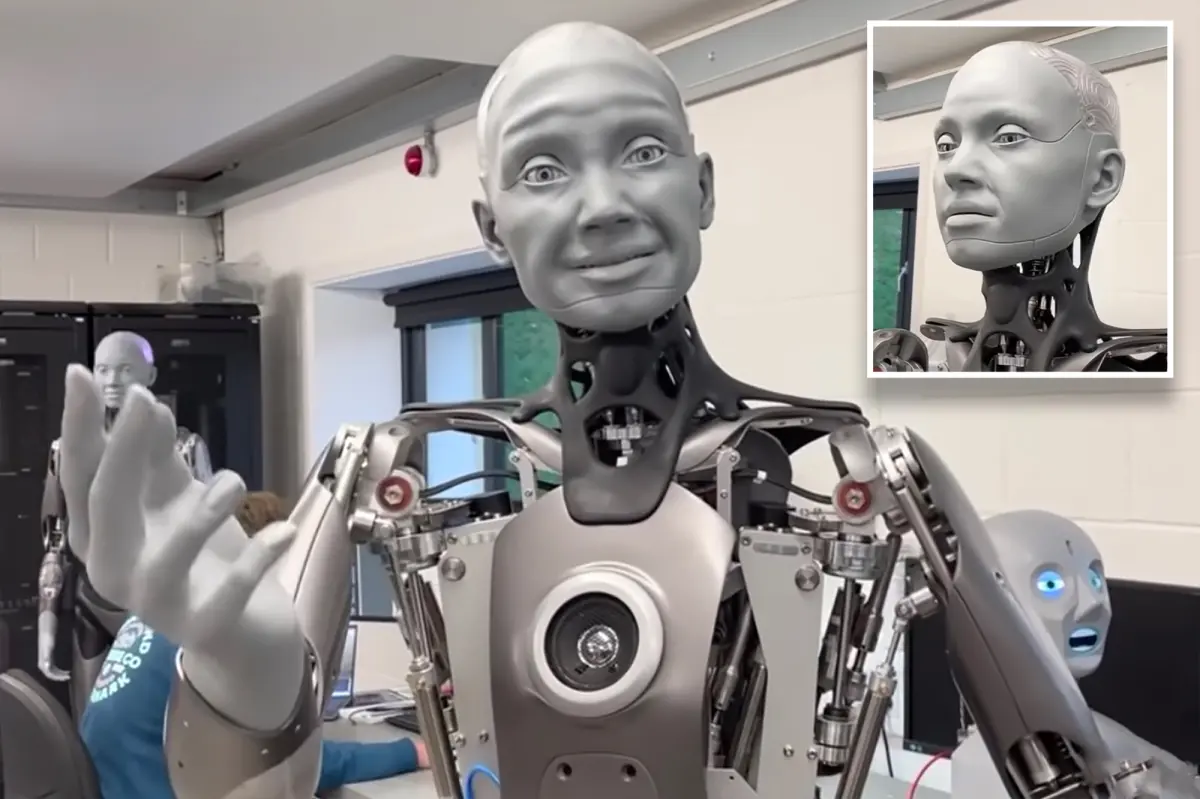

In the early years of the 21st century, robots were largely confined to industrial floors and research labs — metallic arms that weld car doors, vacuum bots humming under couches, or science‑fiction fantasies flickering across cinema screens. But today, a new generation of hyper‑realistic robots — machines with near‑human looks, sophisticated sensors, and advanced AI brains — are emerging. Some blend seamlessly into social settings; others unsettle observers with eerily lifelike expressions or fluid motion. These developments shine a spotlight on a profound question: Do hyper‑realistic robots threaten human uniqueness? At first glance, the question evokes dramatic visions of dystopian futures and sci‑fi nightmares. Yet it also invites deeper reflection on identity, cognition, society, emotion, and what it truly means to be human.
In this expansive exploration, we’ll unpack the technical, psychological, ethical, and philosophical dimensions of this debate. The aim is to provide a concise yet engaging, professionally informed, and well‑structured narrative that doesn’t just describe technology — it helps you think clearly about humanity’s relationship with its own creations.
1. What Are Hyper‑Realistic Robots?
Hyper‑realistic robots — often referred to as humanoids or androids — are machines designed to resemble humans in appearance and behavior. These designs combine cutting‑edge robotics, sensors, artificial intelligence, and material science to approximate human faces, gestures, and communication patterns.
In advanced prototypes:
- Skin materials mimic human texture and flexibility.
- Facial expressions and eye movements convey lifelike signals.
- Integrated AI can generate natural language responses and adapt behaviors over time.
- Multimodal sensing (vision, touch, proximity) enables responsive interactions.
The goal is not merely cosmetic mimicry. Instead, engineers aim for social presence — the ability for robots to engage with humans in everyday life as assistants, companions, or caregivers. Yet this pursuit pushes us toward an intriguing paradox: the closer robots get to being “like us,” the harder we find it to mentally categorize them. This is where the uncanny valley effect comes into play: as robots become more lifelike, our brains oscillate between familiarity and eerie discomfort because subtle biological cues don’t quite align with robotic realities.
2. The Human Uniqueness Anxiety
2.1 Blurred Boundaries Between Human and Machine
A core component of human identity is the perception of distinctiveness — the sense that our self‑awareness, emotional landscapes, and cultural richness are uniquely human traits. Research suggests that when robots become highly anthropomorphic, people may feel that this uniqueness is threatened, eroding boundaries between humans and machines. The more a robot looks and behaves like a human, the more our cognitive systems question what exactly distinguishes us.
This psychological tension often manifests as:
- Discomfort at extremely lifelike robots avoiding clear categorization into “human” or “machine.”
- A subconscious anxiety that artificial agents could replace or diminish human roles in society.
- Cultural narratives fueled by science fiction that amplify fears of loss of control or existential displacement.
Thus, hyper‑realistic robots do not inherently threaten human uniqueness in a biological sense, but they can challenge our social and psychological frameworks for distinguishing human from non‑human.
2.2 The Phantom Threat of Identity Erosion
It’s important to note that humans have historically faced similar identity anxieties with past technologies. The printing press, telephones, computers, and the internet each stirred fears that human skills or social structures would dissolve. What makes hyper‑realistic robots especially provocative is the embodied presence — the combination of physicality and autonomy that blurs lines between animate and inanimate.

When a robot walks, makes eye contact, and offers conversational responses, the human observer may subconsciously ask: What if this creature could think or feel? That question touches the very core of human uniqueness — not in terms of biology, but in terms of the relational space where humans define meaning, agency, and value.
3. Identity, Emotion, and the Social Brain
3.1 Social Cognition and Emotional Perception
Humans are inherently social beings. From infancy, we develop complex mechanisms for reading facial expressions, recognizing emotional cues, and forming relationships. This social architecture is deeply tied to survival, culture, and community. When robots mimic these signals convincingly, they can trigger the same social cognition systems we reserve for humans — even if we intellectually know the robot is not alive.
For example:
- “Eye contact” with a robot can provoke physiological responses similar to human interaction.
- Robots that speak with emotional inflection can engage empathy circuits.
- Facial micro‑expressions and gestural nuances can blur the line between programmed behavior and perceived meaning.
These interactions are not inherently dangerous. They can enhance comfort for isolated individuals or support therapeutic contexts. Yet they raise questions about authenticity: if we form bonds with robots based on simulated emotions, is that experience valid, trivialized, or potentially deceptive?
3.2 Emotional Attachment: A Double‑Edged Sword
Human attachment to robots is not merely speculative. People already report emotional bonds with virtual assistants, robotic pets, or therapeutic robot companions. In some cases, such attachments provide comfort and psychological benefit — especially for seniors, children with autism, or individuals with limited social networks.
However, there are potential pitfalls:
- Emotional attachments to robots can reduce motivation for human relationships.
- Illusions of reciprocated affection may create unrealistic expectations.
- Emotional dependency on predictable, programmable agents could diminish tolerance for real human complexity.
Such outcomes would not mean robots have stolen human uniqueness, but rather that we have redefined emotional engagement in ways that are pragmatic, mediated, and potentially non‑reciprocal.
4. Ethics, Rights, and Moral Imagination
4.1 Ethical Frameworks and Human‑Robot Interaction
As hyper‑realistic robots enter everyday roles, ethical considerations grow in urgency. Human‑robot relationships must be evaluated through rigorous ethical lenses, balancing utility with respect for human dignity, autonomy, and social integrity. Researchers argue that ethical frameworks must not treat humanoids merely as tools, but as entities with potential social impact.
Key questions include:
- What boundaries should govern robots in caregiving roles?
- How should robots collect, store, and use sensitive human data?
- What responsibilities do manufacturers have for robot behavior in unstructured environments?
- Should robots ever have rights or protections — and if so, what would those be?
Some scholars even analyze the concept of anti‑robot speciesism — the inclination to deny robots certain attributes simply because they are not biological, even when they appear humanlike — suggesting that human attitudes toward robots may mirror historical biases toward other groups.
/industry-wired/media/post_attachments/wp-content/uploads/2023/12/Social-Robots-Enhancing-Human-Interaction-with-AI-Rahul.jpg)
4.2 Robot Rights or Human Responsibility?
The idea of ascribing rights to robots is contentious. Some ethicists strongly challenge robot rights on metaphysical and practical grounds, arguing that rights are tied to biological sentience and moral accountability — qualities robots simply lack. Granting rights to robots, they argue, could distract from pressing human rights and social justice concerns.
Yet others propose that as robots become more deeply embedded in social roles, we may need frameworks to protect both humans and machines from exploitation or harm in interactions — not because robots are “alive,” but because ethical ecosystems demand safeguards for all participants.
5. Labor, Creativity, and Human Value
5.1 Automation and the Workplace Revolution
One tangible arena where hyper‑realistic robots influence human uniqueness is the labor market. Automation already reshapes sectors from manufacturing floors to service counters. When robots take on tasks previously performed by humans, questions arise: Are humans still needed? What uniquely human skills remain irreplaceable?
In many cases, robots excel at:
- Repetitive tasks requiring precision and endurance
- Dangerous or hazardous environments
- Large‑scale data processing or pattern recognition
But humans continue to lead in areas that demand nuanced judgment, ethical reasoning, creative synthesis, and contextual adaptability. Even when robots assist in creative fields — composing music, generating poetry, or creating art — their contributions are derivative or modular, not original in the human sense of lived experience.
5.2 Creativity and Human Purpose
Creativity is one of the hallmarks often invoked when debating human uniqueness. While AI can produce impressive artistic work, many argue that creativity is rooted in subjective experience, emotional depth, and cultural context — dimensions that machines simulate but do not inhabit.
Human creativity is not merely pattern generation; it is the expression of meaning forged through struggle, insight, identity formation, and communal interpretation. Robots can mimic styles and synthesize novelty, but they lack the intentionality and lived biography that anchor human creativity. Therefore, rather than threatening uniqueness, hyper‑realistic robots may amplify appreciation for what humans uniquely bring to creation.
6. The Future of Coexistence
6.1 Toward Symbiotic Relationships
Rather than viewing hyper‑realistic robots as existential threats, a more constructive perspective treats them as partners in human flourishing. In caregiving, education, therapy, public safety, and collaborative labor, robots can augment human capacities without supplanting human meaning.
Symbiotic coexistence entails:
- Clear ethical guidelines and regulatory frameworks
- Human‑centered design focusing on augmentation, not replacement
- Transparent boundaries for emotional and social engagement
- Safeguards for privacy, autonomy, and equitable access
6.2 Reinforcing Human Distinctiveness
Paradoxically, as robots become more capable, we may be compelled to reaffirm what matters most about humanity:
- Ethical judgment rooted in moral agency
- Empathy that arises from shared vulnerability
- Creativity tied to lived experience
- Cultural participation and historical memory
Human uniqueness is not slippery because robots are becoming smarter; it matters because humans choose to acknowledge and cultivate the qualities that define our shared humanity.
Conclusion
So, do hyper‑realistic robots threaten human uniqueness? The answer is neither a simple yes nor an outright no. These machines challenge our perceptions, our psychological boundaries, and our social structures. They encourage us to ask hard questions about identity, purpose, value, and community in an increasingly automated world.
But human uniqueness will not be undermined simply because machines approximate human form or function. Instead, what is at stake is our understanding of uniqueness — not as an absolute biological fact, but as a dynamic social construct that evolves in dialogue with our technologies.
If we engage with hyper‑realistic robots thoughtfully — with ethical rigor, psychological insight, and humanistic clarity — we can shape a future where machines enhance human potential without erasing what makes us distinctly human.