








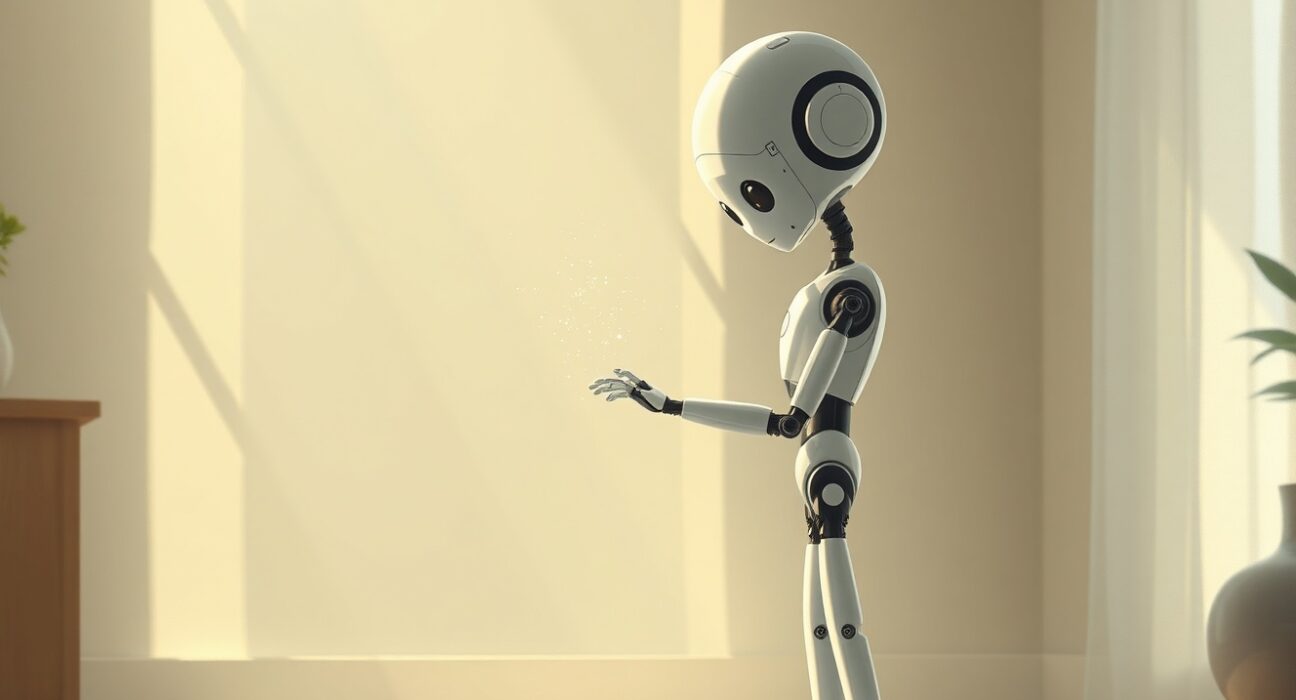

The sci‑fi dream of a home robot helper has edged closer to reality with the launch of Neo, a humanoid robot from the AI and robotics startup 1X Technologies. Marketed as a household assistant capable of performing chores and learning from experience, Neo represents a new frontier in embodied artificial intelligence: robots that learn on their own instead of being trained primarily by human operators.
But as we step back from the hype and examine the mechanics under the hood, a fascinating — and somewhat nuanced — transformation emerges. The real question isn’t simply whether Neo can break free from human‑operated training. It’s whether today’s mix of human teleoperation, autonomous learning, and advanced AI world modeling points toward a future where robots genuinely teach themselves — and if so, what that future looks like.
Human Teleoperation Vs. Autonomous Learning: The Training Spectrum
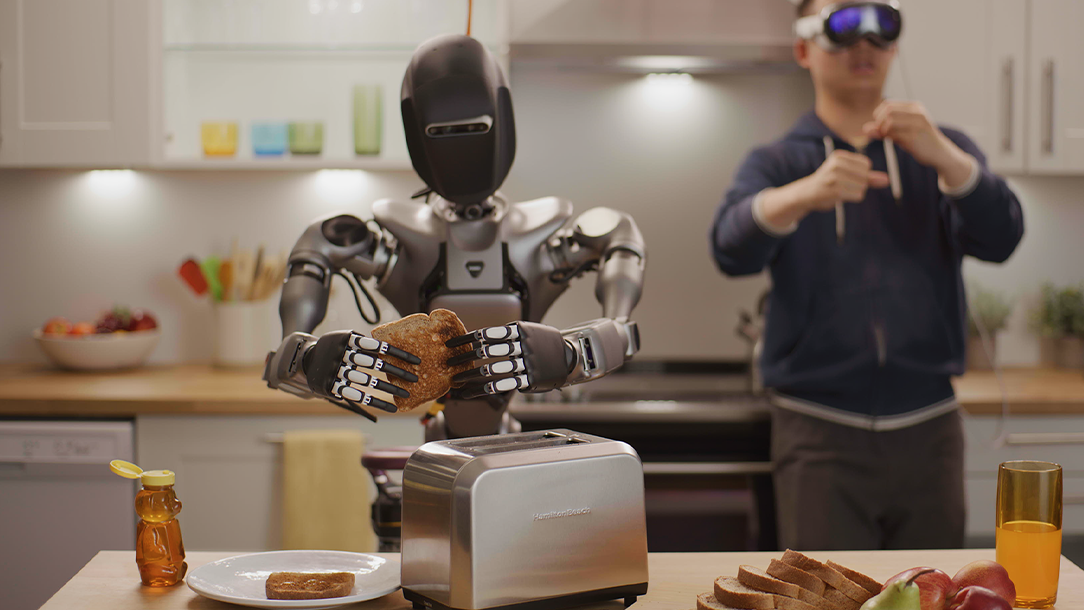
From the earliest research prototypes of humanoid robots to the present, the training of articulated robots has relied heavily on human teleoperation. Engineers have humans wear motion‑capture suits or VR gear to demonstrate tasks limb by limb. The robot watches, records, and learns — but only insofar as it has examples to mimic.
Neo’s early demos followed that familiar pattern: the robot performed tasks like laundry, washing dishes, or tidying up under remote human control. In some cases, every movement was orchestrated by a remote operator guiding Neo from afar, using Neo’s own cameras and sensors as their eyes and hands. This human‑in‑the‑loop strategy supplied training data while completing tasks that the robot’s AI could not yet execute independently — a pragmatic but imperfect bridge to true autonomy.
However, 1X has pivoted from this mode and introduced a new kind of AI training methodology centered on what the company calls its “World Model” — a self‑learning system that marries video data with embodied robot intelligence.
The World Model — Teaching a Robot to Imagine Its Own Actions
At its core, the World Model is not just a perception system. It’s an AI architecture designed to allow Neo to reason about the world from what it sees and predict future outcomes, rather than just imitate motion demonstrations.
Unlike classic teleoperation training — where every task example must be explicitly shown to the robot — Neo’s World Model can interpret video data (both from its own sensors and from large collections of human behavior on video) and generate internal simulations of what should happen next. It’s akin to training a robot to visualize a series of steps before trying them — bridging the gap between observation and autonomous action.
The steps in this learning design include:
- Egocentric training — teaching the AI how to interpret first‑person views of environments and objects.
- Fine‑tuning with robot data — aligning the predictions with Neo’s physical embodiment and movement capabilities.
- Dynamic action planning — using internal physics and visual reasoning to generate sequences of motion that achieve a task goal.
The result is an AI that doesn’t just mimic motion data provided by humans. It develops an internal model of the world: how objects move, how environments respond to force and contact, and how instructions like “pick up the cup” translate into sequences of coordinated actions.
This evolution mirrors broader trends in robotics and AI, where systems are shifting from supervised imitation toward self‑supervised representation learning that draws on observations and internal simulation.
Can Neo Actually Learn “On Its Own”?
The short answer is: partially, and increasingly so.
With its World Model, Neo can take a simple prompt — whether text or voice — interpret what it sees in the environment, and generate an action plan without being coached through the task by a human operator. This means that, for a broad set of routine activities (grabbing an object, navigating a corridor, placing something on a shelf), Neo can now respond autonomously by applying learned general principles rather than just replaying recorded motions.
This is a significant shift in the training paradigm. Instead of relying on thousands of laborious hours of human‑produced teleoperation data, Neo’s AI learns through a blend of onboard perception, simulation, and reinforcement. That, in essence, reduces the dependence on humans as trainers.
That said, human oversight isn’t gone entirely — yet.
In early deployments, Neo still integrates a remote “expert mode” where human operators may step in to complete tasks the robot doesn’t yet master. This serves two purposes:
- Completing everyday tasks reliably for customers today.
- Collecting real‑world training data that accelerates Neo’s autonomous learning.
In some ways, this hybrid strategy resembles approaches in autonomous vehicles where cars learn to navigate roads with occasional human safety drivers before full self‑driving capabilities are proven safe.
The key insight here is that Neo’s autonomy isn’t binary — it’s a spectrum. At one end, Neo acts entirely on its internal AI reasoning. At the other, it accepts human guidance when needed. Over time, the goal is for human involvement to recede, leaving only full autonomy.
Why This Matters: Robots That Can Generalize and Adapt
Why should we care about this shift from human‑operated training to autonomous learning?
The real challenge in robotics isn’t writing code for a handful of scripted motions. It’s generalization — the robot’s ability to handle environments, objects, and tasks it has never encountered before. That’s what separates a novelty demo from a genuinely useful household assistant.

Traditional robot training methods struggle with generalization because they depend on exhaustive examples. Every variation requires a new demonstration. But if a robot can infer new solutions from video data and internal world reasoning — much like humans extrapolate skills from observation — it opens the door to scalable autonomy.
In the longer term, this means:
- Fewer human trainers per robot deployed — intelligence scales with the number of robots rather than operators.
- Faster adaptation to new tasks without retraining on every niche variation.
- Lower training costs by reducing dependency on costly human labor.
- Simultaneous learning and working — robots improving themselves during real use.
These are the ingredients of an AI economy where robots become self‑improving agents rather than static automatons.
Still Early — And Still Imperfect
Even with the World Model, Neo is not yet truly a self‑teaching robot in the fullest sense of autonomy. The robot still exhibits limitations in complex manipulation and dynamic environments, and early units may lean on human expert intervention to fill gaps.
From today’s perspective, Neo’s training evolution looks less like a singular leap to independence and more like a gradual transfer of responsibility from humans to AI systems. Initially, humans show the way, then the AI figures out the rest. Over months and years, that AI knowledge accumulates, giving Neo a richer understanding of how the physical world operates.
Yet this trajectory is still promising. Within a few years, daily household tasks — once rigidly scripted — might become fluid, adaptive behaviors learned by the robot through continuous experience.
In other words, 1X’s Neo is breaking away from human‑operated training, but it’s doing so incrementally — in smart, verifiable steps — not by flipping a switch. The future isn’t a robot that magically wakes up fully autonomous. It’s a robot that learns to live in our world by combining observation, reasoning, and experience.
The Broader Implications for Robotics and AI
Neo’s transition is emblematic of a larger shift across robotics and AI:
- Robots are no longer trained just by engineers. They now learn from the world they inhabit and from the patterns of human behavior encapsulated in video and sensory data.
- Generalist AI models are becoming central to embodied intelligence. Robots equipped with such models can tackle novel tasks with contextual reasoning.
- Human roles are shifting from trainers to supervisors. Instead of demonstrating every task, humans set goals and refine behavior boundaries.
This future is not without challenges — including safety, privacy, and ethics — but it points to a robotics ecosystem where embodied agents participate in the world rather than passively imitate it.
Neo’s progress marks an early chapter in that story: a step toward robots that are less dependent on humans for direction and more capable of autonomous discovery.